MCQ
Assertion : In Young’s experiment, the fringe width for dark fringes is different from that for white fringes.
Reason : In Young’s double slit experiment the fringes are performed with a source of white light, then only black and bright fringes are observed.
  • A
     If both assertion and reason are true and the reason is the correct explanation of the assertion.
  • B
     If both assertion and reason are true but reason is not the correct explanation of the assertion.
  • C
     If assertion is true but reason is false.
  •  If the assertion and reason both are false.
Answer

Correct option: D.
 If the assertion and reason both are false.
 If the assertion and reason both are false.

Need a full question paper?

Generate a complete, print-ready paper with questions like this in minutes — across 16+ boards, with answer keys.

Start Generating Free

Similar questions

The thermal conductivity of a rod depends on:
A point object O is placed on the principal axis of a convex lens of focal length f = 20cm at a distance of 40cm to the left of it. The diameter of the lens is 10cm. An eye is placed 60cm to right of the lens and a distance h below the principal axis. The maximum value of h to see the image is:
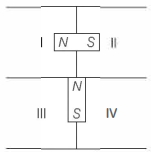
Two identical bar magnets are held perpendicular to each other with a certain separation, as shown below. The area around the magnets is divided into four zones. Given that there is a neutral point it is located in
For production of characteristic ${K_\beta }\,$ $X-$ rays, the electron transition is
Two charges ${q_1}$ and ${q_2}$ are placed in vacuum at a distance $d$ and the force acting between them is $F$. If a medium of dielectric constant $4$ is introduced around them, the force now will be
If a glass rod is rubbed on silk cloth and then brought near the bits of paper it $........$ then.
A light wave is incident normally over a slit of width $24 \times 10^{-5} \mathrm{~cm}$. The angular position of second dark fringe from the central maxima is $30^{\circ}$. What is the wavelength of light
The difference between threshold wavelengths for two metal surfaces $A$ and $B$ having work function $\phi_A=9\,eV$ and $\phi_{ B }=4.5\,eV$ in $nm$ is:(Given, $hc =1242\,eV\,nm$)
Two polaroid sheets are placed one over the other with their axes inclined to each other at $30^{\circ}$. The ratio of the intensity of the unpolarised incident light and the polarised emergent light is 
Which among the following is an application of microwaves?