MCQ
Assertion : Leclanche cell is used, when constant supply of electric current is not required.
Reason : The e.m.f. of a Leclanche cell falls, if it is used continuously.
  •  If both assertion and reason are true and the reason is the correct explanation of the assertion.
  • B
    If both assertion and reason are true but reason is not the correct explanation of the assertion.
  • C
     If assertion is true but reason is false.
  • D
     If the assertion and reason both are false.
Answer

Correct option: A.
 If both assertion and reason are true and the reason is the correct explanation of the assertion.
If both assertion and reason are true and the reason is the correct explanation of the assertion.

Need a full question paper?

Generate a complete, print-ready paper with questions like this in minutes — across 16+ boards, with answer keys.

Start Generating Free

Similar questions

In an $\text{LED}$ device, the intensity of emitted light:
By corpuscular theory of light, the phenomenon which can be explained is
Two spheres $A$ and $B$ of exactly same mass are given equal positive and negative charges respectively. Their masses after charging.
A lens which has focal length of 4 cm and refractive index of 1.4 is immersed in a liquid of refractive index 1.6, then the focal length will be
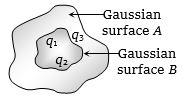
The electric flux for Gaussian surface A that enclose the charged particles in free space is (given $q_1$ = $-14\, nC$, $q_2$ = $78.85\, nC$, $q_3$ = $-56 \,nC$)
Assertion : An induced current has a direction such that the magnetic field due to the current opposes the change in the magnetic flux that induces the current.

Reason : Above statement is in accordance with conservation of energy

Two straight long conductors AOB and COD are perpendicular to each other and carry currents $i_1$ and $i_2$. The magnitude of the magnetic induction at a point P at a distance a from the point O in a direction perpendicular to the plane ACBD is
In hydrogen atom, an electron is revolving in the orbit of radius 0.53$A^0$ with $6.6\times 10^{15}$  rotations/second. Magnetic field produced at the centre of the orbit is
The ${K_\alpha }$ $X$ - rays arising from a cobalt $(z = 27)$ target have a wavelength of $179\, pm$. The ${K_\alpha }$ $X$ - rays arising from a nickel target $(z = 28)$ is
The electrostatic potential on the surface of a charged conducting sphere is $100 V$ . Two statements are made in this regard $S_1$ at any point inside the sphere, electric intensity is zero. $S_2$ at any point inside the sphere, the electrostatic potential is $100 V$ . Which of the following is a correct statement?