Question

Assertion  : Microwave propagation is better than the sky wave propagation.

Reason      :  Microwaves have frequencies 100 to 300 GHz, which have very good directional properties.

(a) If both assertion and reason are true and the reason is the correct explanation of the assertion.

(b) If both assertion and reason are true but reason is not the correct explanation of the assertion.

(c) If assertion is true but reason is false.

(d) If the assertion and reason both are false.

Answer

(a) If both assertion and reason are true and the reason is the correct explanation of the assertion.

Need a full question paper?

Generate a complete, print-ready paper with questions like this in minutes — across 16+ boards, with answer keys.

Start Generating Free

Similar questions

Light of a particular frequency υ is incident on a metal surface. When the intensity of incident radiation is increased, the photoelectric current?
When an impurity is doped into an intrinsic semiconductor, the conductivity of the semiconductor:
  1. Increases.
  2. Decreases.
  3. Remains the same.
  4. Becomes zero.
The plate current in a diode is zero. It is possible that:
Suppose potential energy between electron and proton at separation r is given by U = K ln (r), where K is a constant. For such a hypothetical hydrogen atom, the ratio of energy difference between energy levels (n = 1 and n = 2) and (n = 2 and n = 4) is?

In a triode valve the amplification factor is 20 and mutual conductance is 10–3 mho. The plate resistance is

(a) 2 × 10³ W

(b) 4 × 10³ W

(c) 2 ×10⁴ W

(d) 2 ×10⁴ W

If a steady current of 4 amp maintained for 40 minutes, deposits 4.5 gm of zinc at the cathode and then the electro chemical equivalent will be

(a) 51  

(b) 28 

(c) 32  

(d) 47  

The self inductance L of a solenoid of length l and area of crosssection A, with a fixed number of turns N increases as:

The mass number of a nucleus is equal to the number of

(a) Electrons it contains

(b) Protons it contains

(c) Neutrons it contains

(d) Nucleons it contains

A person can see clearly only upto a distance of 25 cm. He wants to read a book placed at a distance of 50 cm. What kind of lens does he require for his spectacles and what must be its power

(a)  Concave, – 1.0 D

(b)  Convex,  + 1.5 D

(c)  Concave, – 2.0 D

(d)  Convex, + 2.0 D

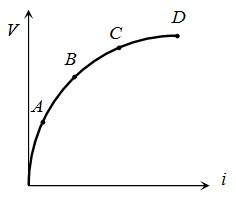
Variation of current passing through a conductor as the voltage applied across its ends as varied is shown in the adjoining diagram. If the resistance (R) is determined at the points A, B, C and D, we will find that

(a) RC = RD

(b) RB > RA

(c) RC > RB

(d) None of these