Question

Assertion :  No interference pattern is detected when two coherent sources are infinitely close to each other.

Reason     : The fringe width is inversely proportional to the distance between the two slits.

(a) If both assertion and reason are true and the reason is the correct explanation of the assertion.

(b) If both assertion and reason are true but reason is not the correct explanation of the assertion.

(c) If assertion is true but reason is false.

(d) If the assertion and reason both are false.

Answer

(b) If both assertion and reason are true but reason is not the correct explanation of the assertion.

Need a full question paper?

Generate a complete, print-ready paper with questions like this in minutes — across 16+ boards, with answer keys.

Start Generating Free

Similar questions

α - particles of energy 400 KeV are bombarded on nucleus of  . In scattering of α - particles, its minimum distance from nucleus will be

(a) 0.59 nm

(b) 0.59 Å

(c) 5.9 pm

(d) 0.59 pm

125 identical drops each charged to the same potential of 50 volts are combined to form a single drop. The potential of the new drop will be

(a) 50 V   

(b) 250 V

(c) 500 V

(d) 1250 V

Which of the following statement is wrong

(a) Infrared photon has more energy than the photon of visible light

(b) Photographic plates are sensitive to ultraviolet  rays

(c) Photographic plates can be made sensitive to infrared rays

(d) Infrared rays are invisible but can cast shadows like visible light rays

A wire is placed parallel to the lines of force in a magnetic field and a current flows in the wire. Then:
The thermal radiation emitted by a body is proportional to Tn where Tis its absolute temperature. The value of n is exactly 4 for:
  1. A blackbody.
  2. All bodies.
  3. Bodies painted black only.
  4. Polished bodies only.

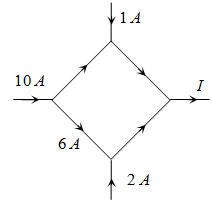
The figure shows a network of currents. The magnitude of currents is shown here. The current I will be

(a) 3 A

(b) 9 A

(c) 13 A

(d) 19 A

The electric potential decreases uniformly from 120V to 80V as one moves on the x-axis from x = -1cm to x = + 1cm. The electric field at the origin.
  1. Must be equal to 20Vcm-1
  2. May be equal to 20Vcm-1
  3. May be greater than 20Vcm-1
  4. May be lees than 20Vcm-1
Which one of the following is inorganic compound semiconductor?
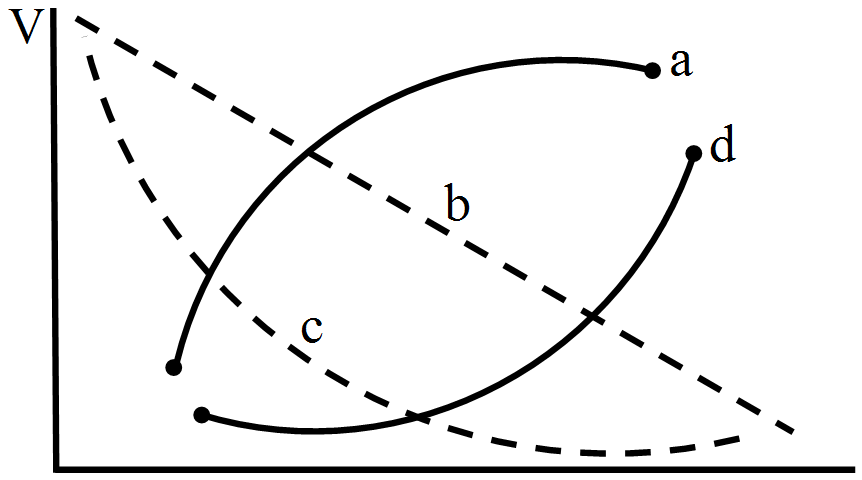
Which of the following curves may represent the speed of the electron in a hydrogen atom as a function of the principal quantum number n?

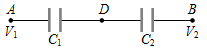
Two condensers  and   in a circuit are joined as shown in figure. The potential of point  A is   and that of  B is. The potential of point D will be

(a)  

(b)  

(c)

(d)