Question
Assertion  :   On going away from a point charge or a small electric dipole, electric field decreases at the same rate in both the cases.
Reason      : Electric field is inversely proportional to square of distance from the charge or an electric dipole.(a) If both assertion and reason are true and the reason is the correct explanation of the assertion.(b) If both assertion and reason are true but reason is not the correct explanation of the assertion.(c) If assertion is true but reason is false.(d) If the assertion and reason both are false.


Answer

(d) If the assertion and reason both are false.
Need a full question paper?

Generate a complete, print-ready paper with questions like this in minutes — across 16+ boards, with answer keys.

Start Generating Free

Similar questions

If heat is supplied to an ideal gas in an isothermal process:
  1. The internal energy of the gas will increase.
  2. The gas will do positive work.
  3. The gas will do negative work.
  4. The said process is not possible.
Three $\alpha -$ particles and one $\beta -$ particle decaying takes place in series from an isotope $88^{\mathrm{Ra}^{288}}$.Finally the isotope obtained will be
The magnetic moment of a bar magnet is thus ...A... to the magnetic moment of an equivalent solenoid that produces the same magnetic field.
Here, A refers to.
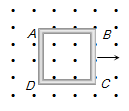
A metallic square loop $\text{ABCD}$ is moving in its own plane with velocity $v$ in a uniform magnetic field perpendicular to its plane as shown in the figure. An electric field is induced
$1$ emu $= ....... C$
The north pole of a long horizontal bar magnet is being brought closer to a vertical conducting plane along the perpendicular direction. The direction of the induced current in the conducting plane will be(a) Horizontal(b) Vertical(c) Clockwise(d) Anticlockwise
       
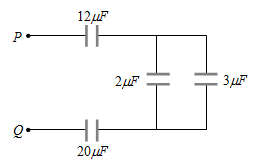
In the circuit diagram shown in the adjoining figure, the resultant capacitance between $P$ and $Q$ is
Three charges each of magnitude $q$ are placed at the corners of an equilateral triangle, the electrostatic force on the charge placed at the center is $($each side of triangle is $L)$
A radioactive material decays by simultaneous emission of two particles with respective half lives 1620 and 810 years. The time (in years) after which one- fourth of the material remains is (a) 1080  (b) 2430(c) 3240  (d) 4860
       
In Young's double slit experiment, 62 fringes are seen in visible region for sodium light of wavelength 5893 Å. If violet light of wavelength 4358 Å is used in place of sodium light, then number of fringes seen will be(a) 54(b) 64(c) 74       (d) 84