Question

Assertion  :   On going away from a point charge or a small electric dipole, electric field decreases at the same rate in both the cases.

Reason      : Electric field is inversely proportional to square of distance from the charge or an electric dipole.

(a) If both assertion and reason are true and the reason is the correct explanation of the assertion.

(b) If both assertion and reason are true but reason is not the correct explanation of the assertion.

(c) If assertion is true but reason is false.

(d) If the assertion and reason both are false.

Answer

(d) If the assertion and reason both are false.

Need a full question paper?

Generate a complete, print-ready paper with questions like this in minutes — across 16+ boards, with answer keys.

Start Generating Free

Similar questions

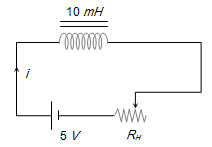
The resistance in the following circuit is increased at a particular instant. At this instant the value of resistance is 10W. The current in the circuit will be now

(a) i = 0.5 A

(b) i > 0.5 A

(c) i < 0.5 A

(d) i = 0

Resistances of 6 ohm each are connected in the manner shown in adjoining figure. With the current 0.5 ampere as shown in figure, the potential difference  is

(a) 3.6 V

(b) 6.0 V

(c) 3.0 V

(d) 7.2 V

The heavier nuclei tend to have larger $\frac{\text{N}}{\text{Z}}$ ratio because:
  1. A neutron is heavier than a proton.
  2. A neutron is an unstable particle.
  3. A neutron does not exert electric repulsion.
  4. Coulomb forces have longer range compared to the nuclear forces.
 For television broadcasting the frequency employed is normally:

A particle with   of charge and   mass is moving with a velocity of   along the y-axis. A uniform static magnetic field B = 0.5 Tesla  is acting along the x-direction. The force on the particle is

(a) 5 ×   along  

(b) 5   along  

(c)  5 ×  along - 

(d) 5   along  - 

For principal quantum number n = 3, the possible values of orbital quantum number ‘l’ are

(a) 1, 2, 3

(b) 0, 1, 2, 3

(c) 0, 1, 2

(d) –1, 0, +1

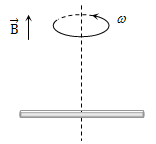
A conducting rod of length 2l is rotating with constant angular speed w about its perpendicular bisector. A uniform magnetic field   exists parallel to the axis of rotation. The e.m.f. induced between two ends of the rod is

(a) Bω    

(b)  Bω

(c)  Bω

(d) Zero

If the net electric flux through a closed surface is zero, then we can infer:
The force that a unit positive charge would experiences if placed at that point is called as _____ due to charge at a point in space.
The ratio of magnetic fields due to a small bar magnet in the end on position to the broad side on position is