MCQ
Assertion : $PbCl_2$ is more stable than $PbCl_4$.

Reason : $PbCl_4$ is powerful oxidising agent.

  • A
    If both Assertion and Reason are correct and the Reason is a correct explanation of the Assertion.
  • If both Assertion and Reason are correct but Reason is not a correct explanation of the Assertion.
  • C
    If the Assertion is correct but Reason is incorrect.
  • D
    If both the Assertion and Reason are incorrect.
Answer

Correct option: B.
If both Assertion and Reason are correct but Reason is not a correct explanation of the Assertion.
b
$Pb^{2+}$ is more stable than $Pb^{4+}$ due to inert pair effect. Due to this reason, $PbCl_4$ decomposer readily into $PbCl_2$ and $Cl_2$

$PbCl_4 \to PbCl_2 + Cl_2$

Thus $Pb^{4+}$ salts are better oxidising agents

Need a full question paper?

Generate a complete, print-ready paper with questions like this in minutes — across 16+ boards, with answer keys.

Start Generating Free

Similar questions

Which of the following salts when dissolved in water will get hydrolysed
Find out the compound which having enol content maximum
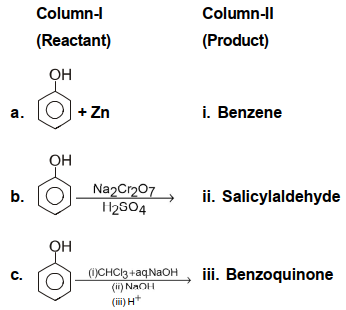
Match the following reactants and reagents given in Column I with the product given in Column II and choose the correct option from the codes given below :
Image
The e.m.f. of a cell whose half cells are given below is .............. $\mathrm{V}$

$Mg^{2+} + 2{e^ - } \to Mg(s)\;E^o = - 2.37\,V$

$Cu^{2+} + 2e^-  \to Cu(s)\;E^o = + 0.34\,V$

In the following reaction sequence, $[ C ]$ is :
$C + \frac{1}{2}{O_2} \to CO;\,\Delta H = - 42\,kJ$

$CO + \frac{1}{2}{O_2} \to C{O_2};\,\Delta H = - 24\,kJ$ The heat of formation of $C{O_2}$ is .....$kJ$

Hydrolysis of one mole of peroxodi-sulphuric acid produces
Number of chiral centre in the given compound is
The $H - H$ bond energy is $ 430\, kJ $ $mol$ and $Cl - Cl$ bond energy is $240\,kJ\,mo{l^{ - 1}}.\,\,\Delta H$ for $HCl$ is $ - 90\,kJ$. The $H - Cl$ bond energy is about.....$kJ\,mo{l^{ - 1}}$
$1\,L,0.02\,M$ solution of $\left[ Co \left( NH _3\right)_5 SO _4\right] Br$ is mixed with $1\,L,0.02\,M$ solution of $\left[ Co \left( NH _3\right)_5 Br _3\right] SO _4$. The resulting solution is divided into two equal parts $(X)$ and treated with excess $AgNO _3$ solution and $BaCl _2$ solution respectively as shown below:$1\,L$ Solution $( X )+ AgNO _3$ solution (excess) $\rightarrow Y$
$1\,L$ Solution $( X )+ BaCl _2$ solution (excess) $\rightarrow Z$
The number of moles of $Y$ and $Z$ respectively are