MCQ
Assertion : Photosensitivity of a metal is high if its work function is small.
Reason : Work function $= hf_0$ where $f_0$ is the threshold frequency.
  • A
    If both Assertion and Reason are correct and the Reason is a correct explanation of the Assertion.
  • If both Assertion and Reason are correct but Reason is not a correct explanation of the Assertion.
  • C
    If the Assertion is correct but Reason is incorrect.
  • D
    If both the Assertion and Reason are incorrect.
Answer

Correct option: B.
If both Assertion and Reason are correct but Reason is not a correct explanation of the Assertion.
b
The photosensitivity of a metal is high when its work function is small. Work function of a metal depends not on the threshold frequency but on the nature of the metal.

Need a full question paper?

Generate a complete, print-ready paper with questions like this in minutes — across 16+ boards, with answer keys.

Start Generating Free

Similar questions

In a circuit, current varies with time as $i = 2\sqrt t $ . Root mean square value of current for interval $t = 2\,s$ to $t = 4\,s$ is
If a dipole of dipole moment $\vec p$ is placed in a uniform electric field $\vec E$, then torque acting on it is given by
In a toroid the number of turns per unit length is $1000$ and current through it is $\frac{1}{4 \pi}$ ampere. The magnetic field produced inside (in $weber / m ^2$ ) will be
Assertion $(A):$ A spherical equipotential surface is not possible for a point charge.

Reason $(R):$ A spherical equipotential surface is possible inside a spherical capacitor.

Function of rectifier is
Two magnets are held together in a vibration magnetometer and are allowed to oscillate in the earth's magnetic field with like poles together, $12$ oscillations per minute are made but for unlike poles together only $4$ oscillations per minute are executed. The ratio of their magnetic moments is
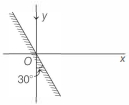
A mirror is placed at an angle of $30^{\circ}$ with respect to $Y$-axis (see figure). A light ray travelling in the negative $y$-direction strikes the mirror. The direction of the reflected ray is given by the vector
Which error is removed when the known and unknown resistances are interchanged in a Meter Bridge?
Two particles of charges $+Q$ and $-Q$ are projected from the same point with a velocity $v$ in a region of uniform magnetic field $B$ such that the velocity vector makes an angle $q$ with the magnetic field. Their masses are $M$ and $2M,$ respectively. Then, they will meet again for the first time at a point whose distance from the point of projection is
A carbon resistance has a following colour code. What is the value of the resistance?