MCQ
Assertion : Potassium ferrocyanide is diamagnetic, whereas potassium ferricyanide is paramagnetic.

Reason : Crystal field splitting in ferrocyanide ion is greater than that of ferricyanide ion.

  • A
    If both Assertion and Reason are correct and the Reason is a correct explanation of the Assertion.
  • B
    If both Assertion and Reason are correct but Reason is not a correct explanation of the Assertion.
  • If the Assertion is correct but Reason is incorrect.
  • D
    If both the Assertion and Reason are incorrect.
Answer

Correct option: C.
If the Assertion is correct but Reason is incorrect.
c
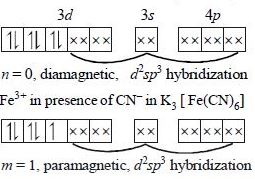
In potassium ferrocyanide, $Fe$ is in the form $Fe^{2+}$ and in potassium ferricyanide, $Fe$ is in the form $Fe^{3+}$.  $CN^-$ is a strong legand. so, it will pair up all the $3d^6$ electrons of $Fe^{3+}$ and make it diamagnetic. In $Fe^{2+}$ , all the $3d^5$ electrons are not paired up. One electron remains unpaired. So, it is paramagnetic. $Fe^{2+}$ in presence of $CN^-$ in $[K_4(Fe(CN)_6)]$.

However, the reson is false because crystal field splitting in ferrocyanide is less than in ferricyanide ion (higher the oxidation state of the metal, geater the crystal field splitting).

Need a full question paper?

Generate a complete, print-ready paper with questions like this in minutes — across 16+ boards, with answer keys.

Start Generating Free

Similar questions

A $KCl$ solution of conductivity $0.14\, S m ^{-1}$ shows a resistance of $4.19 \,\Omega$ in a conductivity cell. If the same cell is filled with an $HCl$ solution, the resistance drops to $1.03 \,\Omega$. The conductivity of the $HCl$ solution is $....... \,\times 10^{-2} \,S m ^{-1}$. (Round off to the Nearest Integer).
Match List $I$ with List $II$

LIST $-I$

(Cell)

LIST $-II$

(Use/Property/Reaction)

$A$ Leclanche

cell

$I$ Converts energy of combustion into electrical energy
$B$ Ni-Cd cell $II$ Does not involve any ion in solution and is used in hearing aids
$C$ Fuel cell $III$ Rechargeable

$D$ Mercury cell

$IV$ Reaction at anode

$\mathrm{Zn} \rightarrow \mathrm{Zn}^{2+}+2 \mathrm{e}^{-}$

Choose the correct answer from the options given below:

How many millilitres of $6.0\,\,M$ hydrochloric acid should be used to prepare $150\,\,ml$ of a solution which is $0.30\,\,M$ in hydrogen ion
In the 'glycolipids', the two sugars known to occur are glucose and
The compound which could not act both as oxidising as well as reducing agent is
The resistance of $0.01\,\, M$ solution of an $Hg_2Cl_2$ electrolyte was found to be $210\,\,= ohm$  at $298\,\, K$  using a conductivity cell of cell constant $0.63\,\, m^{-1}$. The equivalent  conductance of solution is
The four quantum number for the valence shell electron or last electron of sodium $(Z =$ $11$ $)$ is
A $0.2\,molal$ aqueous solution of a weak acid $(HX)$ is $20\% $  ionised. The freezing point of this solution is .............. $^o  \mathrm{C}$   (Given ${K_f} = {1.86^o}\,C/m$ for water)
Which of the following is the least reactive in the case of bromination :
What is the major organic product of the following sequence of reactions ?