Question

Assertion  :  The drift velocity of electrons in a metallic wire will decrease, if the temperature of the wire is increased.

Reason      : On increasing temperature, conductivity of metallic wire decreases.

(a) If both assertion and reason are true and the reason is the correct explanation of the assertion.

(b) If both assertion and reason are true but reason is not the correct explanation of the assertion.

(c) If assertion is true but reason is false.

(d) If the assertion and reason both are false.

Answer

(b) If both assertion and reason are true but reason is not the correct explanation of the assertion.

Need a full question paper?

Generate a complete, print-ready paper with questions like this in minutes — across 16+ boards, with answer keys.

Start Generating Free

Similar questions

If a wire of resistance R is melted and recasted to half of its length, then the new resistance of the wire will be

(a) R/4    

(b) R/2

(c) R 

(d) 2R

The minimum orbital angular momentum of the electron in a hydrogen atom is:
  1. $\text{h}$
  2. $\frac{\text{h}}{2}$
  3. $\frac{\text{h}}{2\pi}$
  4. $\frac{\text{h}}{\lambda}$

When a positive q charge is taken from lower potential to a higher potential point, then its potential energy will

(a) Decrease

(b) Increases

(c) Remain unchanged

(d) Become zero

64 drops of mercury each charged to a potential of 10V. They are combined to form one bigger drop. The potential of this drop will be (Assume all the drops to be spherical)

(a) 160 V

(b) 80 V

(c) 10 V   

(d) 640 V

Rate of change of torque τ with deflection θ is maximum for a magnet suspended freely in a uniform magnetic field of induction B, when

(a) θ = 0°

(b) θ = 45°

(c) θ = 60°

(d) θ = 90°

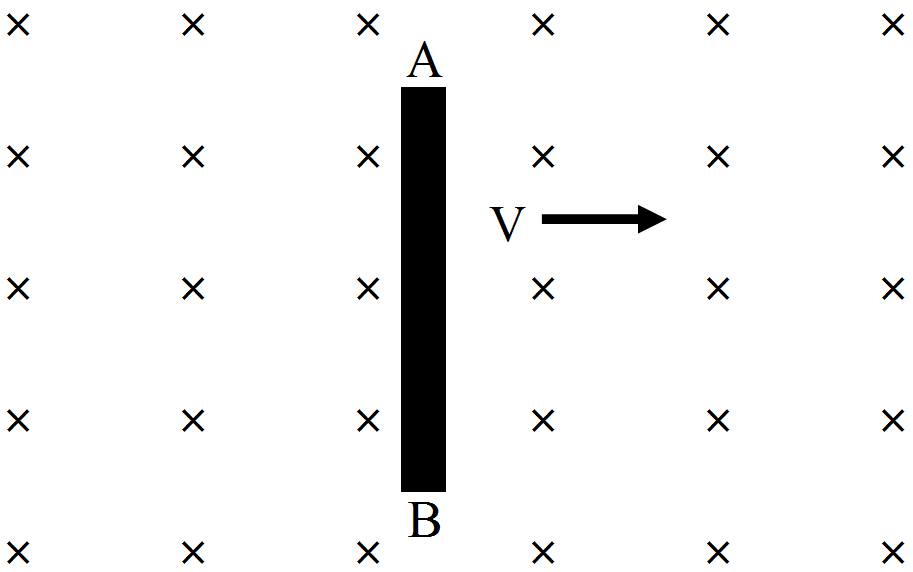
A rod AB moves with a uniform velocity v in a uniform magnetic field as shown in figure.
  1. The rod becomes electrically charged.
  2. The end A becomes positively charged.
  3. The end B becomes positively charged.
  4. The rod becomes hot because of Joule heating.

The distance between the plates of a parallel plate condenser is 4mm and potential difference is 60 volts. If the distance between the plates is increased to 12mm, then

(a) The potential difference of the condenser will become 180 volts

(b) The P.D. will become 20 volts

(c) The P.D. will remain unchanged

(d) The charge on condenser will reduce to one third

The resistance of a coil is 4.2 Ω at 100 oC and the temperature coefficient of resistance of its material is 0.004/o C.  Its resistance at 0o C is

(a) 6.5 Ω

(b) 5 Ω

(c) 3 Ω

(d) 4 Ω

When stopping potential is applied in an experiment on photoelectric effect, no photocurrent is observed. This means that:
  1. The emission of photoelectrons is stopped.
  2. The photoelectrons are emitted but are reabsorbed by the emitter metal.
  3. The photoelectrons are accumulated near the collector plate.
  4. The photoelectrons are dispersed from the sides of the apparatus.
For the same speed, de Broglie wavelength.