MCQ
$Assertion :$ The isothermal curves intersect each other at a certain point.
$Reason :$ The isothermal change takes place slowly, so, the isothermal curves have very little slope.
  • A
    If both Assertion and Reason are correct and the Reason is a correct explanation of the Assertion.
  • B
    If both Assertion and Reason are correct but Reason is not a correct explanation of the Assertion.
  • C
    If the Assertion is correct but Reason is incorrect.
  • If the Assertion is incorrect but the Reason is correct.
Answer

Correct option: D.
If the Assertion is incorrect but the Reason is correct.
d
Isothermal curves have slope which is equal to $\frac{P}{V}$. It can be calculated as follows $PV = RT$ Differentiating, $PdV + VdP = 0$ $-\frac{dP}{dV} = \frac{P}{V}$ Now, if they cut each other at certain point, they will have different slope at the same point (for same value of $P$ and $V$). So, they can not cut each other at some point. Reason is true, slope is $\frac{P}{V}$ . For adiabatic curve slope is $\gamma $ times $\frac {P}{V}$ .

Need a full question paper?

Generate a complete, print-ready paper with questions like this in minutes — across 16+ boards, with answer keys.

Start Generating Free

Similar questions

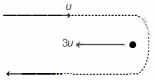
A spacecraft which is moving with a speed $u$ relative to the earth in the $x$-direction, enters the gravitational field of a much more massive planet which is moving with a speed $3 \,u$ in the negative $x$-direction. The spacecraft exits following the trajectory as shown below. The speed of the spacecraft with respect to the earth a long a time after it has escaped the planet's gravity is given by
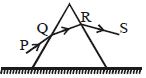
An equilateral prism is placed on a horizontal surface. A ray $PQ$ is incident onto it. For minimum deviation
The binding energy per nucleon is maximum in the case of
There is formation of layer of snow $x\,cm$ thick on water, when the temperature of air is $ - {\theta ^o}C$ (less than freezing point). The thickness of layer increases from $x$ to $y$ in the time $t$, then the value of $t$is given by
In sum and difference method in vibration magnetometer, the time period is more if
At what height above the surface of earth the value of $"g"$ decreases by $2 \%$ ..... $km$ [radius of the earth is $6400 \,km$ ]
A stream-lined body falls through air from a height $h$ on the surface of liquid. Let $d$ and $D$ denote the densities of the materials of the body and the liquid respectively. If  $D > d$, then the time after which the body will be instantaneously at rest, is
Which of the following particles are constituents of the nucleus
What is/are the same for $O_2$ and $NH_3$ in gaseous state
There are $0.8 \times 10^{23}$ free electrons $/ cm^3$ in copper. If $0.2\, A $ current is  flowing is copper wire, then the drift velocity of electrons will be, if the cross sectional area  of wire is $0.01 \,cm^2$