MCQ
Assertion : The poles of magnet cannot be separated by breaking into two pieces.
Reason : The magnetic moment will be reduced to half when a magnet is broken into two equal pieces.
  • A
    If both assertion and reason are true and the reason is the correct explanation of the assertion.
  • If both assertion and reason are true but reason is not the correct explanation of the assertion.
  • C
    If assertion is true but reason is false.
  • D
    If the assertion and reason both are false.
Answer

Correct option: B.
If both assertion and reason are true but reason is not the correct explanation of the assertion.
 If both assertion and reason are true but reason is not the correct explanation of the assertion.

Need a full question paper?

Generate a complete, print-ready paper with questions like this in minutes — across 16+ boards, with answer keys.

Start Generating Free

Similar questions

In the given electromagnetic wave $E_y=600 \sin (\omega t-k x) \mathrm{Vm}^{-1}$, intensity of the associated light beam is (in $\mathrm{W} / \mathrm{m}^2$ ); (Given $\in_0=$ $\left.9 \times 10^{-12} \mathrm{C}^{-2} \mathrm{~N}^{-1} \mathrm{~m}^{-2}\right)$
In an electron gun the control grid is given a negative potential relative to cathode in order to:
The lines joining the places of the same horizontal intensity are known as
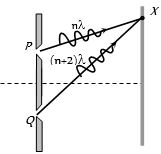
The figure shows a double slit experiment $P$ and $Q$ are the slits. The path lengths $PX $ and $ QX $ are $n\lambda $ and $(n + 2)\lambda $ respectively, where $n $ is a whole number and $\lambda $ is the wavelength. Taking the central fringe as zero, what is formed at $X$
A filament bulb $(500 \,W,\,\, 100 \,V)$ is to be used in a $230\, V$ main supply. When a resistance $R$ is connected in series, it works perfectly and the bulb consumes $500\,W.$ The value of $R$ is .................. $\Omega$
A coil of inductance $40 \,henry$ is connected in series with a resistance of $8\,\Omega$ and the combination is joined to the terminals of a $2\,volt$ battery. The time constant of the circuit is......$seconds$
What is the Brewster angle for air to glass transition? (Refractive index of glass $= 1.5.)$
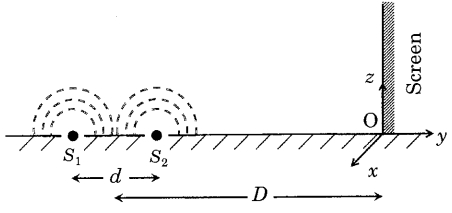
While conducting the Young's double slit experiment, a student replaced the two slits with a large opaque plate in the $x-y$ plane containing two small holes that act as two coherent point sources $\left(S_1, S_2\right)$ emitting light of wavelength $600 \mathrm{~nm}$. The student mistakenly placed the screen parallel to the $x-z$ plane (for $z>0$ ) at a distance $D=3 \mathrm{~m}$ from the mid-point of $S_1 S_2$, as shown schematically in the figure. The distance between the sources $d=0.6003 \mathrm{~mm}$. The origin $\mathrm{O}$ is at the intersection of the screen and the line joining $S_1 S_2$. Which of the following is(are) true of the intensity pattern on the screen?

($A$) Straight bright and dark bands parallel to the $x$-axis

($B$) The region very close to the point $O$ will be dark

($C$) Hyperbolic bright and dark bands with foci symmetrically placed about $\mathrm{O}$ in the $x$-direction

($D$) Semi circular bright and dark bands centered at point $\mathrm{O}$

If a proton is projected in a direction perpendicular to a uniform magnetic field with velocity $v$ and an electron is projected along the lines of force, what will happen to proton and electron
Assertion : If the speed of charged particle increases both the mass as well as charge increases.
Reason : If $m_0 =$ rest mass and $m$ be mass at velocity $v$ then $m = \frac{{{m_0}}}{{\sqrt {1 - \frac{{{v^2}}}{{{c^2}}}} }}$ where $c =$ speed of light