MCQ
Assertion : When a metal is treated with conc. $HNO_3$ it generally yields a nitrate, $NO_2$
and $H_2O$.

Reason : Conc. $HNO_3$ reacts with metal and first produces a metal nitrate and nascent hydrogen. The nascent hydrogen then further reduces $HNO_3$ to $NO_2$.

  • If both Assertion and Reason are correct and the Reason is a correct explanation of the Assertion.
  • B
    If both Assertion and Reason are correct but Reason is not a correct explanation of the Assertion.
  • C
    If the Assertion is correct but Reason is incorrect.
  • D
    If both the Assertion and Reason are incorrect.
Answer

Correct option: A.
If both Assertion and Reason are correct and the Reason is a correct explanation of the Assertion.
a
Both assertion and reason are true and reason is the correct explanation of assertion.

$\underset{\text{(metal)}}{\mathop{M}}\,\,+\,\underset{\text{(conc}\text{.)}}{\mathop{HN{{O}_{3}}}}\,\,\to \,\underset{\text{(metal nitrate)}}{\mathop{MN{{O}_{3}}\,}}\,$ $+\,\underset{\text{(nascent hydrogen)}}{\mathop{H}}\,\,+\,2HN{{O}_{3}}\,+\,$ $\underset{\text{(nascent hydrogen)}}{\mathop{2H}}\,\,\to 2N{{O}_{2}}\,+\,2{{H}_{2}}O$

Need a full question paper?

Generate a complete, print-ready paper with questions like this in minutes — across 16+ boards, with answer keys.

Start Generating Free

Similar questions

When chlorine water is added to a solution of $KBr$, the solution immediately turns orange red, because
The activation energy of a reaction can be determined from the slope of which of the following graphs ?
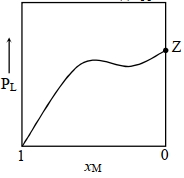
For a solution formed by mixing liquids $L$ and $M$, the vapour pressure of $L$ plotted against the mole fraction of $M$ in solution is shown in the following figure. Here $x_{L}$ and $x_M$ represent mole fractions of $L$ and $M$, respectively, in the solution. The correct statement(s) applicable to this system is(are)

(image)

$[A]$ Attractive intermolecular interactions between $L-L$ in pure liquid $L$ and $M-M$ in pure liquid $M$ are stronger than those between $L-M$ when mixed in solution

$[B]$ The point $Z$ represents vapour pressure of pure liquid $M$ and Raoult's law is obeyed when $x_{L} \rightarrow 0$

$[C]$ The point $Z$ represents vapour pressure of pure liquid $L$ and Raoult's law is obeyed when $x_{\mathrm{L}} \rightarrow 1$

$[D]$ The point $Z$ represents vapour pressure of pure liquid $M$ and Raoult's law is obeyed from $x_{L}=0$ to $x_{L}=1$

${\lambda _{ClC{H_2}COONa}} = 224\;oh{m^{ - 1}}\,c{m^2}\,gme{q^{ - 1}}$,

${\lambda _{NaCl}} = 38.2\;oh{m^{ - 1}}\,c{m^2}\,gme{q^{ - 1}}$,

${\lambda _{HCl}} = 203\;oh{m^{ - 1}}\,c{m^2}\,gme{q^{ - 1}}$,

What is the value of ${\lambda _{ClC{H_2}COOH}}$ .............. ${\rm{Oh}}{{\rm{m}}^{ - 1}}{\mkern 1mu} {\rm{c}}{{\rm{m}}^2}{\rm{gm}}\,{\rm{e}}{{\rm{q}}^{ - 1}}$

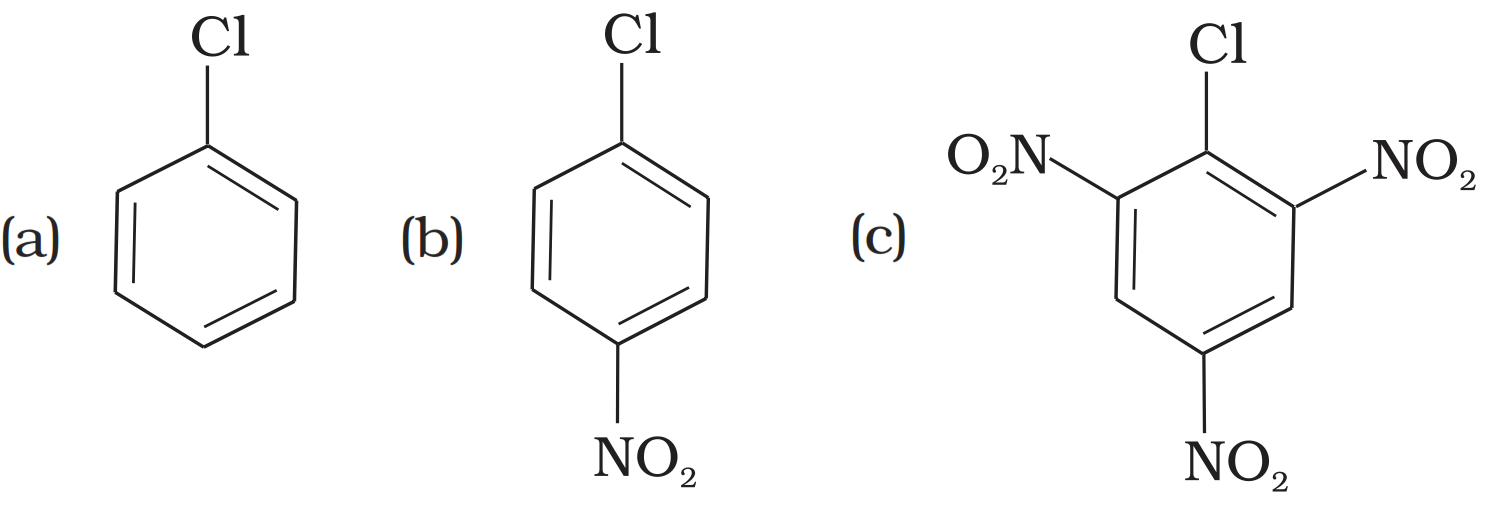
Note: In the questions arrange the compounds in increasing order of rate of reaction towards nucleophilic substitution.

Which of the following statements about zero order reaction is not true
Which of the following Xenon compound does not produce explosive $XeO_3$ on its complete hydrolysis?
Given are cyclohexanol $(I),$ acetic acid $(II),$ $2,4,6-$trinitrophenol $(III)$ and phenol $(IV).$ In these the order of decreasing acidic character will be
In spectro chemical series, the positions occupied by the ligands $Cl^-, OH^-, CN^-$ in the increasing splitting power is
Molecular formula ${C_6}{H_{12}}{O_6}$ is of