Question

Assertion  :   When charges are shared between any two bodies, no charge is really lost, but some loss of energy does occur.

Reason      : Some energy disappears in the form of heat, sparking etc.

(a) If both assertion and reason are true and the reason is the correct explanation of the assertion.

(b) If both assertion and reason are true but reason is not the correct explanation of the assertion.

(c) If assertion is true but reason is false.

(d) If the assertion and reason both are false.

Answer

(b) If both assertion and reason are true but reason is not the correct explanation of the assertion.

Need a full question paper?

Generate a complete, print-ready paper with questions like this in minutes — across 16+ boards, with answer keys.

Start Generating Free

Similar questions

The half life (T) and the disintegration constant (λ) of a radioactive substance are related as

(a) λT  = 1

(b) λT = 0.693

(c)   

(d)  

In Young's double slit experiment, the interference pattern obtained with white light will be:

If the wavelength of light is 4000 Å, then the number of waves in 1 mm length will be

(a) 25

(b) 0.25

(c) 0.25  

(d) 25  

You are given four sources of light each one providing a light of a single colour – red, blue, green and yellow. Suppose the angle of refraction for a beam of yellow light corresponding to a particular angle of incidence at the interface of two media is 90º. Which of the following statements is correct if the source of yellow light is replaced with that of other lights without changing the angle of incidence?

64 drops each having the capacity C and potential V are combined to form a big drop. If the charge on the small drop is q, then the charge on the big drop will be

(a) 2q

(b) 4q

(c) 16q

(d) 64q

A combination of two thin lenses with focal lengths  and  respectively forms an image of distant object at distance 60 cm when lenses are in contact. The position of this image shifts by 30 cm towards the combination when two lenses are separated by 10 cm. The corresponding values of  and  are

(a) 30 cm,-60 cm

(b) 20 cm, -30 cm

(c) 15 cm, -20 cm

(d) 12 cm,  - 15 cm

The rest energy of an electron is 0.511 MeV. The electron is accelerated from rest to a velocity 0.5 c. The change in its energy will be

(a) 0.026 MeV

(b) 0.051 MeV

(c) 0.079 MeV

(d) 0.105 MeV

A charged ball B hangs from a silk thread S, which makes an angle θ with a large charged conducting sheet  P, as shown in the figure. The surface charge density σ  of the sheet is proportional to

(a) sin θ  

(b) tan θ 

(c) cos θ

(c) cos θ

Polarisation of light was first successfully explained by:
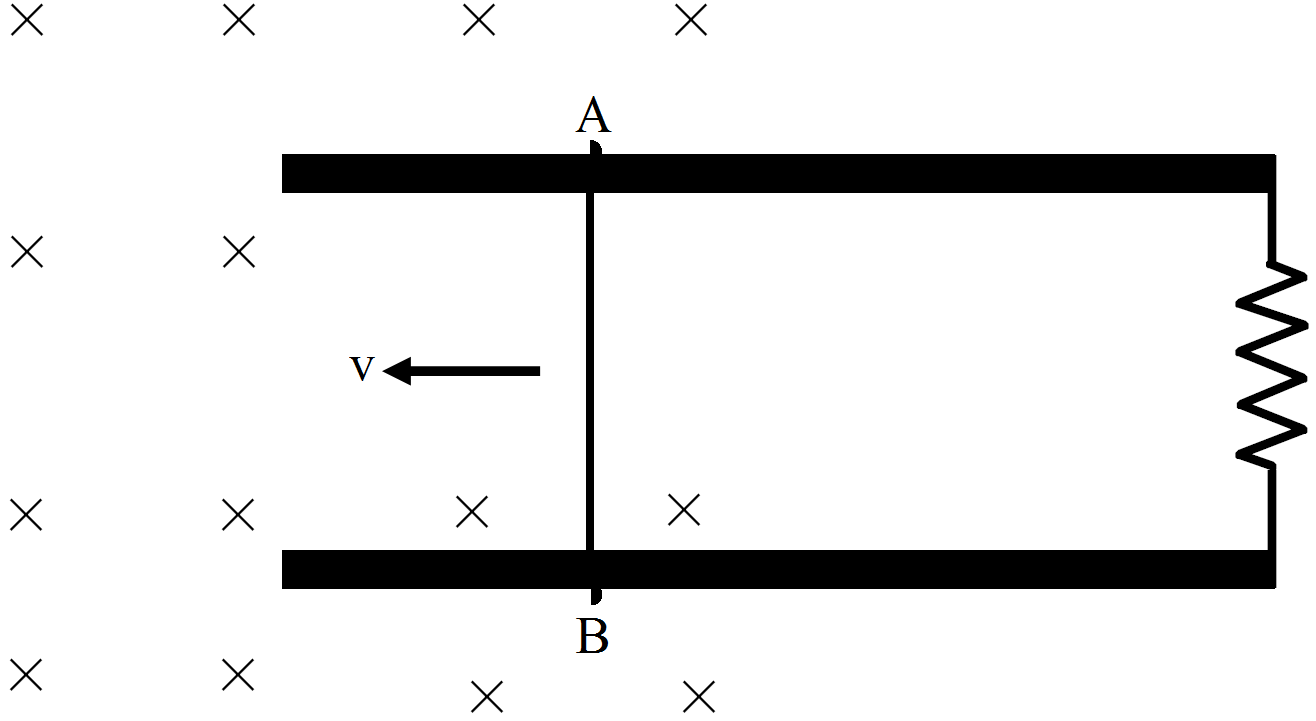
Consider the situation shown in figure. The wire AB is slid on the fixed rails with a constant velocity. If the wire AB is replaced by a semicircular wire, the magnitude of the induced current will: