Question

Assertion :   X-rays cannot be diffracted by means of grating.

Reason     : X-rays does not obey Bragg's law.

(a) If both assertion and reason are true and the reason is the correct explanation of the assertion.

(b) If both assertion and reason are true but reason is not the correct explanation of the assertion.

(c) If assertion is true but reason is false.

(d) If the assertion and reason both are false.

Answer

(c) If assertion is true but reason is false.

Need a full question paper?

Generate a complete, print-ready paper with questions like this in minutes — across 16+ boards, with answer keys.

Start Generating Free

Similar questions

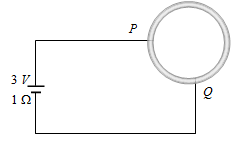
A wire of resistance 10 W is bent to form a circle. P and Q are points on the circumference of the circle dividing it into a quadrant and are connected to a Battery of 3 V and internal resistance 1 W as shown in the figure.  The currents in the two parts of the circle are

(a)    and

(b)   and

(c)   and

(d)   and

A radioactive nucleus undergoes a series of decay according to the scheme A   If the mass number and atomic number of A are 180 and 72  respectively, then what are these number for A4

(a) 172 and 69

(b) 174 and 70

(c) 176 and 69

(d) 176 and 70

Two bulbs of 500 watt and 200 watt are manufactured to operate on 220 volt line. The ratio of heat produced in 500 W and 200 W, in two cases, when firstly they are joined in parallel and secondly in series, will be

(a)  

(b)  

(c)  

(d)  

The 21 cm radio wave emitted by hydrogen in interstellar space is due to the interaction called the hyperfine interaction is atomic hydrogen. the energy of the emitted wave is nearly

(a)  Joule

(b) 1 Joule

(c) 7  Joule

(d)  Joule

In a microscope, the focal length of the objective lens in comparison to focal length of the eye lens is :
In the Boolean algebra, the following one is wrong:

Given three equal resistors, how many different combination of all the three resistors can be made

(a) Six

(b) Five

(c) Four

(d) Three

A plano-convex lens is made of refractive index of 1.6. The radius of curvature of the curved surface is 60 cm. The focal length of the lens is

(a) 400 cm

(b) 200 cm

(c) 100 cm

(d) 50 cm

Fusion reactions take lace at high temperature because:

Which of the following is electromagnetic wave

(a) X-rays and light waves

(b) Cosmic rays and sound waves

(c) Beta rays and sound waves

(d) Alpha rays and sound waves