Question
Assess the developments which were the root cause of the confrontation between the Union Government and the Judiciary in India in 1970s.

Answer

Confrontation between Union Government and Judiciary in 1970s Three constitutional issues-
  • Can Parliament abridge Fundamental Rights? Supreme Court said it cannot.
  • Can Parliament curtail the Right to Property by making amendment? The court said that Parliament cannot amend the constitution in such a manner that rights are curtailed.
  • Parliament amended the constitution saying that it can abridge Fundamental Rights for giving effect to Directive Principles.
Supreme Court rejected this provision.
  • This caused crises in relations between the government and the judiciary.
  • In 1978 Chief Justice of India has appointed by violating the seniority criterion by appointing A.N. Roy and ignoring seniority of three judges.
  • Climax came when the High Court declared Indira Gandhi’s election, invalid.

Need a full question paper?

Generate a complete, print-ready paper with questions like this in minutes — across 16+ boards, with answer keys.
Start Generating Free

Similar questions

Explain the internal divisions of the State of Jammu and Kashmir and describe how these lead to multiple regional aspirations in that State.
Read the passage given below carefully and answer the following questions:
Just as both internal and external factors guide the behavior of an individual or a family, both domestic and international environment influence the foreign policy of a nation. The developing countries lack the required resources to effectively advocate their concerns in the international system. So, they pursue more modest goals than the advanced states. They focus more on peace and development in their own neighbourhood. Moreover, their economic and security dependence on the more powerful states occasionally influences their foreign policy. In the period immediately after the Second World War, many developing nations chose to support the foreign policy preferences of the powerful countries, who were giving them aid or credits. This resulted in the division of countries of the world into two clear camps.
  1. Give one example each of the domestic as well as international environment that has influenced the foreign policy of India.
  2. Why do the developing countries focus more on peace and development in their own neighbourhood?
  3. Mention the two super blocs the world was divided into.
Examine any three major areas of conflict between India and Pakistan.
Analyse the circumstances responsible for the declaration of a state of emergency in India on $25^{th}$ June $1975$.
What was Shock Therapy? Was this the best way to make a transition from communism to capitalism?
Assess the role of ASEAN as an economic association.
How did the reorganisation of States take place in India after its independence? Explain.
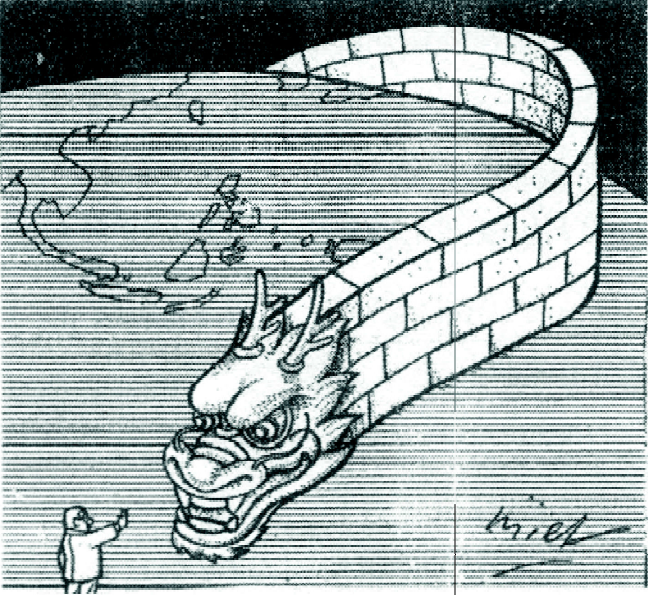
Study the cartoon given below carefully and answer the following questions:
  1. Which country does the given cartoon refer to?
  2. Identify the two symbols in this cartoon which have given you the clue about the related country.
  3. Where does the cartoon place the related country in the international power politics?
Explain any two points of conflict between India and Bangladesh.
Read carefully the passage given below and answer the following questions:
The New Congress had something that its big opponents lacked - it had an issue, an agenda and a positive slogan. The Grand Alliance did not have a coherent political programme. Indira Gandhi said that the opposition alliance had only one common programme 'Indira Hatao'. In contrast to this, she put forward a positive programme captured in the famous slogan 'Garibi Hatao'.
  1. Which Congress is being referred to as 'The New Congress'?
  2. Highlight any two steps taken by Indira Gandhi to remove poverty.
  3. How far is it justified to call the 'Opposition Alliance' as the 'Grand Alliance'?