Question
Assign reason for the following:
i. $BaSO _4$ is insoluble although ionic in nature.
ii. $ClF _3$ has only $90^{\circ}$ bond angles.
iii. $SO _2$ is angular but $SO _3$ is planar.
iv. $NH _3$ and $PH _3$ have same hybridization but different bond angle.
v. $CuSO _4 \cdot 5 H _2 O$ loses $4 H _2 O$ on heating but not the fifth molecule.
Answer

  1. $BaSO_4$ is insoluble in water because lattice energy is more than hydration energy (energy released when $\text{Ba}^{2+}$ and $\text{SO}^{2-}_4$ get attracted by water molecules)
  2. $ClF_3$​​​​​​​ has three bonded pair which are at $90^\circ $ but lone pair of electrons are at equatorial position at angle $120^\circ $ so as to minimize repulsion.
  3. $SO_2$ has 1 lone pair, therefore, it is bent molecule, $SO_3$ does not have lone pair.
$\therefore$ $SO_2$ is planar.
  1. ' N ' is smaller in size and more electronegative than ' P ' therefore in $NH _3$ bond angle is $107^{\circ}$ but in $PH _3$ it is $94.5^{\circ}$. As the size of central atom increases, bond angle decreases.
$[\text{Cu}(\text{H}_2\text{O})_4]\text{SO}_4\dots\text{H}_2\text{O}\xrightarrow{\ \ \text{heat}\ \ }\text{CuSO}_4\dots\text{H}_2\text{O}+4\text{H}_2\text{O}$
  1. $CuSO_4.5H_2O$ loses $4$ molecules of water which are forming coordinate bond with $Cu^{2+}$ but does not lose $H_2O$ molecule, which is H-bonded.

Need a full question paper?

Generate a complete, print-ready paper with questions like this in minutes — across 16+ boards, with answer keys.

Start Generating Free

Similar questions

Explain the mechanism of sulphonation and Friedel Crafts reaction.
The pH of 0.1M solution of cyanic acid (HCNO) is 2.34. Calculate the ionization constant of the acid and its degree of ionization in the solution.
What does atomic radius and ionic radius really mean to you?
When a mixture of ammonium chloride and potassium dichromate was heated, a stable colourless gas ‘A’ is evolved which did not support combustion, but Mg continued burning in it. The gas reacted with $CaC_2$ in electric furnace forming a solid 'B'. Which was slowly hydrolysed by water forming a insoluble substance 'C' and a solution of substance 'D' which turns red litmus blue and gives white fumes with conc HCl to form ‘E'. Identify A to E and write chemical reactions involved.
What is Homologous series? Give its salient features.
Following results are observed when sodium metal is irradiated with different wavelengths. Calculate
  1. Threshold wavelength.
  2. Planck’s constant.
$\lambda\text{(nm)}$ 500 450 400
$\text{v}\times10^{-5}(\text{cm s}^{-1})$ 2.55 4.35 5.35
Explain why cation are smaller and anions larger in radii than their parent atoms?
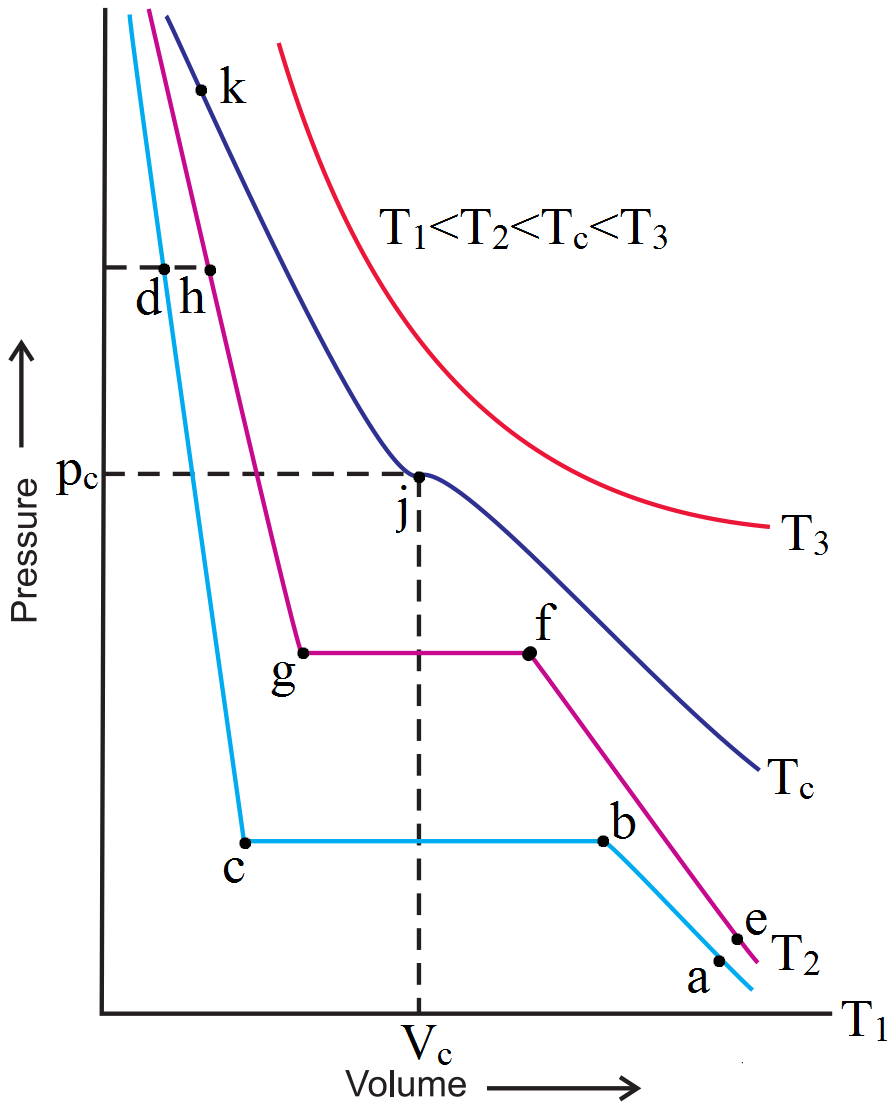
Isotherms of carbon dioxide at various temperatures are represented in the figure. Answer the following questions based on the figure.

i. In which state will $CO _2$ exist between the points a and b at temperature $T _1$ ?
ii. At what point will $CO _2$ start liquefying when temperature is $T _1$ ?
iii. At what point will $CO _2$ be completely liquefied when temperature is $T _2$ ?
iv. Will condensation take place when the temperature is $T_3$ ?
v. What portion of the isotherm at $T _1$ represent liquid and gaseous $CO _2$ at equilibrium?
In astronomical observations, signals observed from the distant stars are generally weak. If the photon detector receives a total of $3.15 \times 10^{–18}J$ from the radiations of $600nm$, calculate the number of photons received by the detector.
What is the pH of 0.001M aniline solution? The ionization constant of aniline can be taken from Table 7.7. Calculate the degree of ionization of aniline in the solution. Also calculate the ionization constant of the conjugate acid of aniline.