Question
Assume that each atom in a copper wire contributes one free electron. Estimate the number of free electrons in a copper wire having a mass of $6.4g$ (take the atomic weight of copper to be $64g$ mol$^{-1}.$

Answer

64 grams of copper have 1 mole
6.4 grams of copper have 0.1 mole
1 mole = No atoms
0.1 mole = (no × 0.1) atoms
$= 6 \times 10^{23}\times 0.1$ atoms $= 6 \times 10^{22}$ atoms
1 atom contributes 1 electron
$6 \times 10^{22}$ atoms contributes $6 \times 10^{22}$ electrons.

Need a full question paper?

Generate a complete, print-ready paper with questions like this in minutes — across 16+ boards, with answer keys.
Start Generating Free

Similar questions

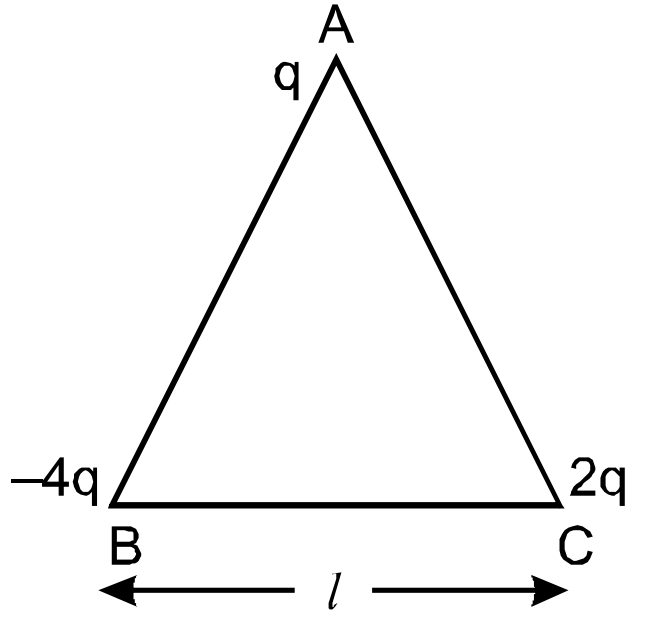
  1. Three point charges q, -4q and 2q are placed at the vertices of an equilateral triangle ABC of side ‘l’ as shown in the figure. Obtain the expression for the magnitude of the resultant electric force acting on the charge q.
  1. Find out the amount of the work done to separate the charges at infinite distance.
Two isolated metal spheres A and B have radii R and 2R respectively, and same charge q. Find which of the two spheres have greater energy density just outside the surface of the spheres.
Consider the plane S formed by the dipole axis and the axis of earth. Let P be point on the magnetic equator and in S. Let Q be the point of intersection of the geographical and magnetic equators. Obtain the declination and dip angles at P and Q.
An electric bulb of volume 250cc was sealed during manufacturing at a pressure of $10^{-3}mm$ of mercury at $27^\circ C.$ Compute the number of air molecules contained in the bulb. Avogadro constant $= 6 \times 10^{23}mol^{-1}$, density of mercury $= 13600kg/ m^{-3} and g = 10ms^{-2}.$
A galvanometer coil has a resistance of 12 Ω and the metre shows full scale deflection for a current of 3 mA. How will you convert the metre into a voltmeter of range 0 to 18 V?
  1. Draw the energy level diagram showing the emission of b-particles followed by γ-rays by a $\text{ }^{60}_{27}\text{Co}$ nucleus.
  2. Plot of distribution of KE of b-particles is shown in fig. (b).
Can we find the mass of a photon by the definition p = mv?
A spacecraft consumes more fuel in going from the earth to the moon than it takes for a return trip. Comment on this statement.
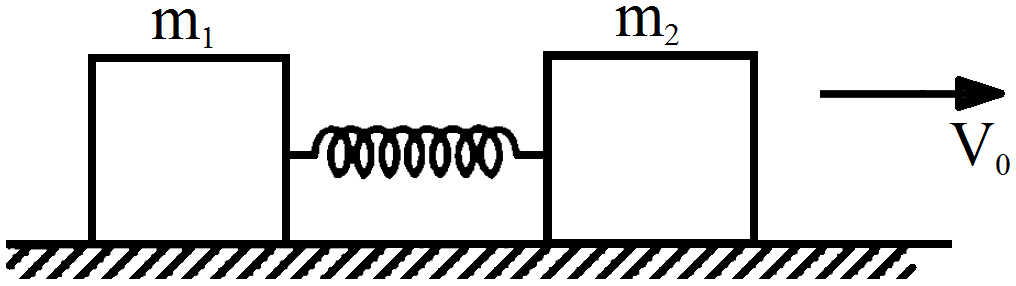
Two blocks of masses $m_1$ and $m_2$ are connected by a spring of spring constant k. The block of mass $m_2$ is given a sharp impulse so that it acquires a velocity $v_0$ towards right. Find
  1. The velocity of the centre of mass.
  2. The maximum elongation that the spring will suffer.
Draw a labelled diagram of Hertz’s experimental set-up to produce electromagnetics waves. Explain the generation of electromagnetic waves using this set-up.