MCQ
At a given temperature the force between molecules of a gas as a function of intermolecular distance is:
  • A
    First decreases and then increases
  • B
    Always increases
  • C
    Always decreases
  • D
    Always constant

Answer

  1. First decreases and then increases

Need a full question paper?

Generate a complete, print-ready paper with questions like this in minutes — across 16+ boards, with answer keys.
Start Generating Free

Similar questions

A passeger sitting in a train facing towards the engine. The train is moving with a constant velocity. The passenger throws a ball upwards, then the ball will return:
A man is at rest in the middle of a pond on perfectly smooth ice. He can get himself to the shore by making use of Newton's
A marble block of mass $2\, kg$ lying on ice when given a velocity of $6\, m/s$ is stopped by friction in $10s$. Then the coefficient of friction is-
Two vibrating strings of the same material but lengths $L$ and $2L$ have radii $2r$ and $r$ respectively. They are stretched under the same tension. Both the strings vibrate in their fundamental modes, the one of length $L$ with frequency $n_1$ and the other with frequency $n_2$. The ratio $n_1/n_2$ is given by
A particle executes simple harmonic motion between x = -A and x = +A. The time taken for it to go from 0 to $\frac{\text{A}}{2}$ is T1 and to go from $\frac{\text{A}}{2}$ to A is T2 Then:
A block slides down an inclined plane of slope of angle $\theta $ with a constant velocity. It is then projected up the plane with an initial velocity $u$. The distance upto which it will rise before coming to rest is
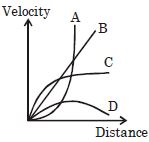
A small spherical solid ball is dropped in a viscous liquid. Its journey in the liquid is best  described in the figure drawn by:-
Motion of an oscillating liquid column in a U-tube is:
  1. Periodic but not simple harmonic.
  2. Non-periodic.
  3. Simple harmonic and time period is independent of the density of the liquid.
  4. Simple harmonic and time-period is directly proportional to the density of the liquid.
The dimensions of Stefan-Boltzmann's constant $\sigma$ can be written in terms of Planck's constant $h$, Boltzmann's constant $k_B$ and the speed of light $c$ as $\sigma=h^\alpha k_B^\beta c^\gamma$. Here,
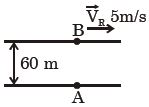
A man is crossing a river flowing with velocity of $5\, m/s$. He reaches a point directly across at a distance of $60\, m$ in $5\, sec$. His velocity in still water should be........$m/s$