MCQ
At constant volume, temperature is increased. Then
  • A
    Collision on walls will be less
  • Number of collisions per unit time will increase
  • C
    Collisions will be in straight lines
  • D
    Collisions will not change

Answer

Correct option: B.
Number of collisions per unit time will increase
b
As the temperature increases, the average velocity of the molecules will increase, resulting in faster collisions.

Need a full question paper?

Generate a complete, print-ready paper with questions like this in minutes — across 16+ boards, with answer keys.
Start Generating Free

Similar questions

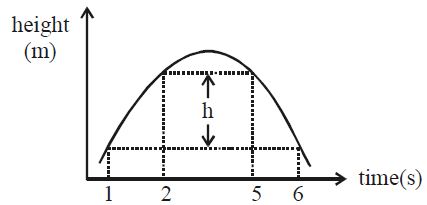
A ball is thrown upwards. Its height varies with time as follows If the acceleration due to gravity is $7.5\, m/s^2$, then the height $h$ is.........$m$
The kinetic energy of $SHM$ is $1/n$ time its potential energy. If the amplitude of the $SHM$ be $A$, then what is the displacement of the particle?
If the ratio of cross-sections of a tube of unequal radius at two places is $1: 2$, then for an in compressible fluid the ratio of the velocities of the fluid entering and exiting the tube will be :
The maximum horizontal range of a projectile is $160\, m$. When the projectile is thrown  with the same speed at an elevation of $30^o$ from the horizontal, it will reach to the  maximum height of   ......... $m$
Which of the following option correctly describes the variation of the speed $v$  and acceleration $'a'$  of a point mass falling vertically in a viscous medium that applies a force $F = -kv,$ where $'k'$  is a constant, on the body? (Graphs are schematic and not drawn to scale)
The temperature of a wire of length $1$ metre and area of cross-section $1\,c{m^2}$ is increased from $0°C$ to $100°C$. If the rod is not allowed to increase in length, the force required will be $(\alpha = {10^{ - 5}}/^\circ C$ and $Y = {10^{11}}\,N/{m^2})$
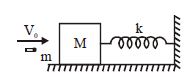
A bullet of mass $m$ strikes a block of mass $M$ connected to a light spring of stiffness $k$ , with a speed $V_0$ . If the bullet gets embedded in the block then, the maximum compression in the spring is
Two blocks $A$ and $B$ are released from the top of a rough inclined plane so that $A$ slides along the plane and $B$ falls down freely. Which will have higher velocity on reaching the ground ?
A gas is allowed to expand isothermally. The root mean square velocity of the molecules
Two simple pendulums of length $5m$ and $10m$ respectively are given small linear displacement in one direction at the same time. They will be again in the phase when the pendulum of shorter length has completed oscillations: