Question
At nodes in stationary waves

Answer

(a) In a longitudinal standing wave, such as in an organ pipe, there are fixed locations in the pipe where molecules oscillate back and forth at maximum amplitude, but there is no variation in $pressure- the$ density remains constant; this is a pressure node. At $1 / 4$ wavelength away from this node there is a pressure antinode, where the density alternates from high to low, with corresponding alternations in pressure. At the center of this antinode there is no particle motion, but particles on either side alternately move toward and away from the centre

Need a full question paper?

Generate a complete, print-ready paper with questions like this in minutes — across 16+ boards, with answer keys.
Start Generating Free

Similar questions

In the phenomenon of interference :-
$(a)$ Total energy is conserved
$(b)$ Total energy is not conserved
$(c)$ Only bright fringe are formed
$(d)$ The frequency of two sources is equal
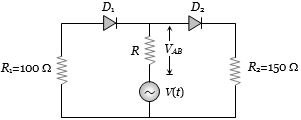
In the circuit given below, $V(t) $ is the sinusoidal voltage source, voltage drop $V_{AB}(t) $ across the resistance $R$  is
A particle of mass $1\, {kg}$ is hanging from a spring of force constant $100\, {Nm}^{-1 .}$ The mass is pulled slightly downward and released so that it executes free simple harmonic motion with time period ${T}$. The time when the kinetic energy and potential energy of the system will become equal, is $\frac{{T}}{{x}}$. The value of ${x}$ is ..... .
The total radiative power emitted by spherical black body with radius $R$ and temperature $T$ is $P$. If the radius is doubled and the temperature is halved, then the radiative power will be
If masses of two point objects are tripled and distance between them is doubled, then gravitational force of attraction between them will .......... $\%$
The magnetic compass is not useful for navigation near the magnetic poles because
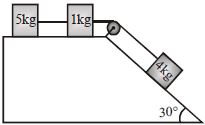
What will be the acceleration of the system and tension in the rope connecting $5\,kg$ and  $1\,kg$ :-
The relation between the number of free electrons in semiconductors $(n) $ and its temperature $ (T)$ is
A body of mass $5\, kg$ under the action of constant force $\overrightarrow F  = {F_x}\hat i + {F_y}\hat j$ has velocity at $t\,= 0\, s$ as $\overrightarrow v  = \left( {6\hat i - 2\hat j\,m/s} \right)$  and at $t\, = 10\,s$ as $\overrightarrow v  = +6\hat j\,m/s$. The force $\overrightarrow F $ is 
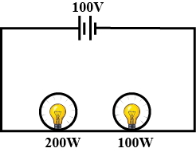
Two bulbs, one of $200 \,W$ and the other of $100 \,W$ are connected in series with a $100 \,V$ battery which has no internal resistance. Then,