Question
At noon, the sun and the earth pull the objects on the earth's surface in opposite directions. At midnight the sun and the earth pull these objects in same direction. Is the weight of an object, as measured by a spring balance on the earth's surface, more at midnight as compared to its weight at noon?
Answer

No. Due to the revolution of the Earth around the Sun, the gravitational force of the Sun on the Earth system is almost zero. Hence, the body will not experience any force due to the Sun. Therefore, weight of the object will remain the same.

Need a full question paper?

Generate a complete, print-ready paper with questions like this in minutes — across 16+ boards, with answer keys.

Start Generating Free

Similar questions

The ground state energy of hydrogen atom is –13.6 eV. What are the kinetic and potential energies of the electron in this state?
Write the difference between polar and non-polar dieelctric.
Draw the graph between the frequency of the incident light and the stopping potential in the experiment of photoelectric.
A proton and a deuteron have the same velocity; what is the ratio of their de Broglie wavelengths?
Light is incident from glass $(\mu=1.5)$ to air. Sketch the variation of the angle of deviation $\delta$ with the angle of incident i for 0 < i < 90°.
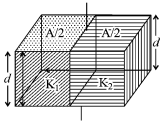
Two dielectric blocks (whose dielectric constants are $K_1$ and $K_2$, respectively) are filled between the plates of a parallel plate capacitor as shown in the figure. What will be the capacitance of the capacitor?
Image
Two capacitors of capacitance 6 μF an 12 μF are connected in series with a battery. The voltage across the 6 capacitor is 2 V. Compute the total battery voltage.
How are infrared waves produced? Why are these referred to as 'heat waves'? Write their one important use.
A proton and an alpha particle having the same kinetic energy are, in turn, passed through a region of the uniform magnetic field, acting normal to the plane of the paper and travel in circular paths. Deduce the ratio of the radii of the circular paths described by them.
A block of mass 250g slides down an incline of inclination 37° with a uniform speed. Find the work done against the friction as the block slides through 1.0m.