Question
At what distance should two charges, each equal to $1C,$ be placed so that the force between them equals your weight?

Answer

Given: $q_1 = q_2 = 1C$ By Coulomb's law, the force of attraction between the two charges is given by
$\text{F}=\frac{1}{4\pi\in_0}\frac{\text{q}_1\text{q}_2}{\text{r}^2}$
$=\frac{9\times10^9\times1\times1}{\text{r}^2}$
However, the force of attraction is equal to the weight $(F = mg).$
$\therefore\text{mg}=\frac{9\times10^9}{\text{r}^2}$
$\Rightarrow\text{r}^2=\frac{9\times10^9}{\text{m}\times10}=\frac{9\times10^8}{\text{m}} ($Taking $g = 10\ m/s^2)$
$\Rightarrow\text{r}^2=\frac{9\times10^8}{\text{m}}$
$\Rightarrow\text{r}=\frac{3\times10^4}{\sqrt{\text{m}}}$
Assuming that $m = 81\ kg,$
we have:$\text{r}=\frac{3\times10^4}{\sqrt{81}}$
$=\frac{3}{9}\times10^4\text{m}$
$=3333.3\text{m}$
$\therefore$ The distance $r$ is $3333.3m.$

Need a full question paper?

Generate a complete, print-ready paper with questions like this in minutes — across 16+ boards, with answer keys.
Start Generating Free

Similar questions

A wheel of moment of inertia $0.500\ kg-m^2$ and radius $20.0\ cm$ is rotating about its axis at an angular speed of $20.0\ rad/s.$ It picks up a stationary particle of mass $200g$ at its edge. Find the new angular speed of the wheel.
At room temperature (27.0 ${ }^{\circ} C$) the resistance of a heating element is 100 Ω. What is the temperature of the element if the resistance is found to 117 Ω, given that the temperature coefficient of the material of the resistor is $1.70 \times 10^{-4}{ }^{\circ} C ^{-1}$.
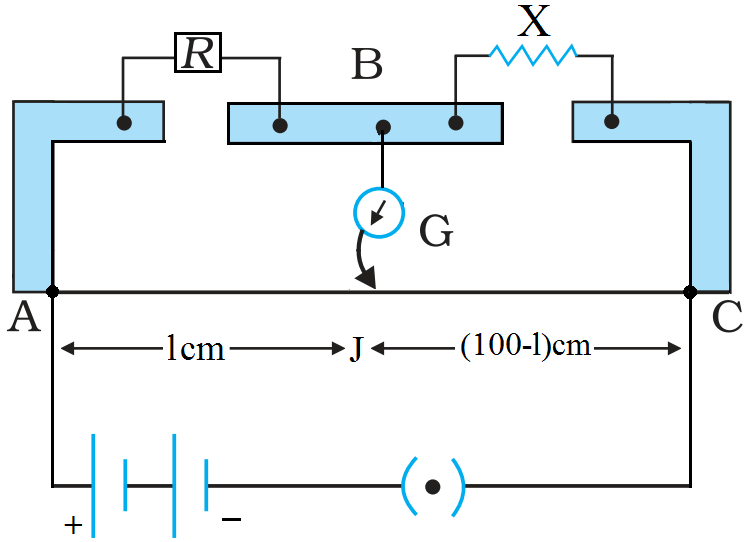
A resistance $\text{R}=4\Omega$ is connected to one of the gaps in a meter bridge, which uses a wire of length 1m. An unknown resistance $\text{x}>4\Omega$ is connected in the other gap as shown in the figure. The balance point is noticed at ‘l’ cm from the positive end of the battery. On interchanging R and X, it is found that the balance point further shifts by 20cm (away from the end A). Neglecting the end correction calculate the value of unknown resistance ‘X’ used.
A cubical box of volume $216\ cm^3$ is made up of $0.1\ cm$ thick wood. The inside is heated electrically by a $100W$ heater. It is found that the temperature difference between the inside and the outside surface is $5^\circ C$ in steady state. Assuming that the entire electrical energy spent appears as heat, find the thermal conductivity of the material of the box.
A circular hole of diameter $2.00\ cm$ is made in an aluminium plate at $0^\circ C$. What will be the diameter at $100^\circ C$? $\alpha$ for aluminium $= 2.3 \times 10^{-5 }{}^{\circ} C^{-1}.$
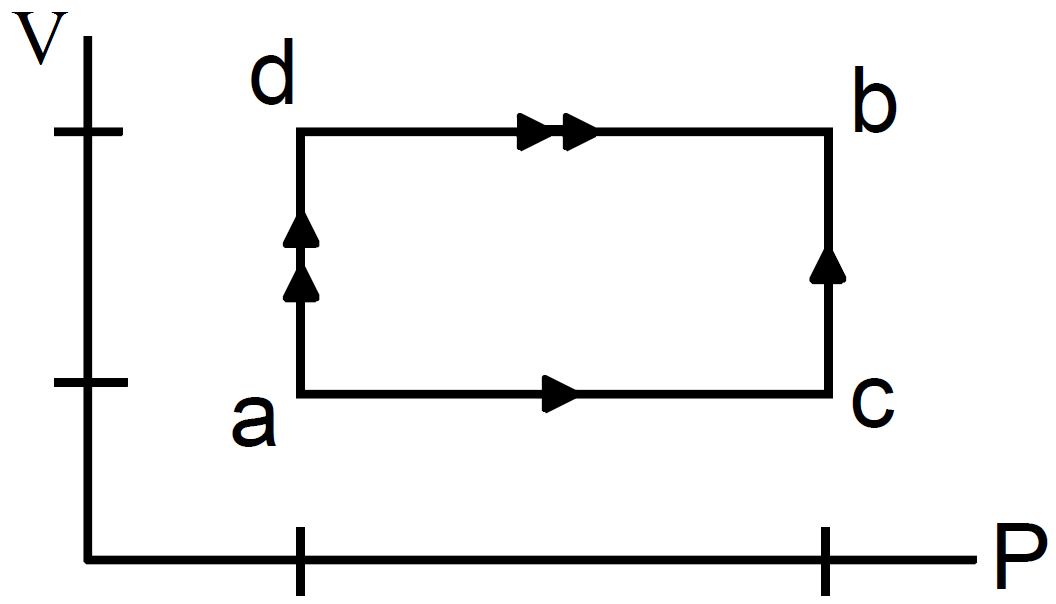
When a system is taken through the process abc shown in figure. 80J of heat is absorbed by the system and 30J of work is done by it. If the system does 10J of work during the process adc, how much heat flows into it during the process?
Draw the electric field lines due to a uniformly charged thin spherical shell when charge on the shell is (a) positive and (b) negative.
Draw a plot of potential energy of a pair of nucleons as a function of their separations. Mark the regions where the nuclear force is (i) attractive and (ii) repulsive. Write any two characteristic features of nuclear forces.
In $H _2$ atom, $r_0$ is radius of first Bohr's orbit. What will be the radius of second orbit? What will be the radius of single ionized helium atom?
The diameter of the sun is $1.4 \times 10^9m$ and its distance from the earth is $1.5 \times 10^{11}m$. Find the radius of the image of the sun formed by a lens of focal length $20\ cm.$