MCQ
Atomic mass is equal to:
  • A
    Number of electrons of an atom.
  • Sum of the numbers of electrons and protons of an atom.
  • C
    Sum of the numbers of neutrons and protons of an atom.
  • D
    None of these.

Answer

Correct option: B.
Sum of the numbers of electrons and protons of an atom.

Need a full question paper?

Generate a complete, print-ready paper with questions like this in minutes — across 16+ boards, with answer keys.

Start Generating Free

Similar questions

Melting points are normally the highest for
$KMn{O_4}$ acts as an oxidising agent in the neutral medium and gets reduced to $Mn{O_2}$. The equivalent weight of $KMn{O_4}$ in neutral medium
The $IR$ stretchin frequencies of free $CO,$ and $CO$ in $[V(CO)_6]^-, [Cr(CO)_6]^-$ and $[Mn(CO)_6]^-$ are $2143\,cm^{-1} , 1860\,cm^{-1} , 2000 \,cm^{-1}$ and $2090 \,cm^{-1}$ , respectively. Then correct statement about metal  carbonyls is
$X$ is
Consider the following transformations:

$(I)$ $XeF_6 +NaF \to  Na^+ [XeF_7]^-$    $(II)$ $2PCl_5(s) \to  [PCl_4]^+[PCl_6]^-$

$(III)$ $[Al(H_2O)_6]^{3+} + H_2O \to  [Al(H_2O)_5OH]^{2+} + H_3O^+$

Possible transformations are:

Given below are two statements : one is labelled as Assertion $(A)$ and the other is labelled as Reason $(R)$.

Assertion $(A)$ : Experimental reaction of $CH _{3} Cl$ with aniline and anhydrous $AlCl _{3}$ does not give $o$ and $p-methylaniline$.

Reason $(R)$ : The - $NH _{2}$ group of aniline becomes deactivating because of salt formation with anhydrous $AlCl _{3}$ and hence yields $m$-methyl aniline as the product.

In the light of the above statements, choose the most appropriate answer from the options given below.

Sodium benzene sulphonate reacts with $ NaOH$  and then on acidic hydrolysis, it gives
The vapour pressure of two liquids $ P $ and $Q $ are $ 80 $ and $60\,torr$, respectively. The total vapour pressure of solution obtained by mixing $3\,mole$ of $ P $ and $ 2\,mole$ of $ Q $ would be .......... $torr$.
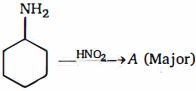
Product $(A)$ is
Identify the correct set of reagents or reaction conditions ' $\mathrm{X}$ ' and ' $\mathrm{Y}$ ' in the following set of transformation.