Question
Atomic radius of fcc is
|
(a) |
(b) |
(c) |
(d) |
Atomic radius of fcc is
|
(a) |
(b) |
(c) |
(d) |
(b) 
Generate a complete, print-ready paper with questions like this in minutes — across 16+ boards, with answer keys.
Four charges are arranged at the corners of a square ABCD, as shown in the adjoining figure. The force on the charge kept at the centre O is
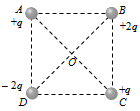
|
(a) Zero |
(b) Along the diagonal AC |
|
(c) Along the diagonal BD |
(d) Perpendicular to side AB |
A convex lens of focal length f produces an image  times than that of the size of the object. The distance of the object from the lens is
|
(a) nf |
(b) |
(c) (n + 1)f |
(d) (n – 1)f |
Nuclear fusion is common to the pair
|
(a) Thermonuclear reactor, uranium based nuclear reactor |
|
(b) Energy production in sun, uranium based nuclear reactor |
|
(c) Energy production in sun, hydrogen bomb |
|
(d) Disintegration of heavy nuclei, hydrogen bomb |
Two coherent sources S1 and S2 are separated by a distance four times the wavelength l of the source. The sources lie along y axis whereas a detector moves along + x axis. Leaving the origin and far off points the number of points where maxima are observed is
|
(a) 2 |
(b) 3 |
(c) 4 |
(d) 5 |
If a photon has velocity c and frequency n, then which of following represents its wavelength
|
(a) |
(b) |
(c) |
(d) hv |
Peltier coefficient for the junction of a pair of metals is proportional to
|
(a) T absolute temperature of the junction |
|
(b) Square of absolute temperature of the junction |
|
(c) |
|
(d) |


