MCQ
Atoms combine through the :
  • A
    Interaction of protons
  • B
    Presence of catalyst
  • Interaction of electrons
  • D
    Rise in temperature

Answer

Correct option: C.
Interaction of electrons
Atoms are unstable, either they lack electrons or they have excess of them in their valence shell.
Therefore atoms combine with other atoms to become stable i.e. to get nearest noble gas configuration.

Need a full question paper?

Generate a complete, print-ready paper with questions like this in minutes — across 16+ boards, with answer keys.
Start Generating Free

Similar questions

he common refrigerant chlorofluoromethane $($Freon$)$ and $\text{NOx}$​ is a serious pollutant because?
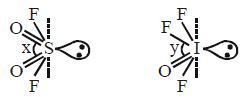
Compare $x$ and $y$ bond angles for the above given molecules
The $I UPAC$ name of $\begin{matrix}
   C{{H}_{3}}-CO-CH-C{{H}_{2}}-C{{H}_{2}}Cl  \\
   |\,\,\,\,\,\,\,\,\,\,\,\,  \\
   C{{H}_{3}}\,\,\,\,\,\,\,  \\
\end{matrix}$ is
$[IMAGE]\,\,\xrightarrow[\Delta ]{{Alc.KOH}}$  Major product
The energy of the electron in the first orbit of $He^+$ is $-871.6\times 10^{-20}\,J$. The energy of the electron in the first orbit of hydrogen would be
A reaction that takes place with the absorption of energy is
The conversion of normal-butane to iso-butane is known as :
$2.4\,g$ coal is burnt in a bomb calorimeter in excess of oxygen at $298\,K$ and $1\,atm$ pressure.The temperature of the calorimeter rises from $298\,K$ to $300\,K$. The enthalpy change during the combustion of coal is $- x\,kJ\,mol ^{-1}$. The value of $x$ is . (Nearest Integer)(Given : Heat capacity of bomb calorimeter $20.0\,kJ$ $K ^{-1}$. Assume coal to be pure carbon)
Which of the following will supress the ionisation of acetic acid in aqueous solution?
Consider the following reactions:

$(i)$  $H_{(aq)}^+ + OH^-= H_2O_{(l)} ,$   $\Delta H = -X_1\,kJ \,mol^{-1}$

$(ii)$  $H_{2(g)} + \frac{1}{2}O_{2(g)} = H_2O_{(l)},$   $\Delta H = -X_2\,kJ \,mol^{-1}$

$(iii)$  $CO_{2(g)} + H_{2(g)} = CO_{(g)} + H_2O_{(l)},$   $\Delta H = -X_3\, kJ\, mol^{-1}$

$(iv)$  $ C_2H_{2(g)}+  \frac{5}{2} O_{2(g)} = 2CO_{2(g)} + H_2O_{(l)},$   $\Delta H = -X_4\,kJ \,mol^{-1}$

Enthalpy of formation of $H_2O_{(l)}$ is