Question
Attempt any five of the following:
$(a)$ Define native state in reference to proteins.
$(b)$ Define the following terms:
$a.$ Polysaccharides
$b.$ Nucleotides
$(c)$ Deficiency of which vitamin causes scurvy?
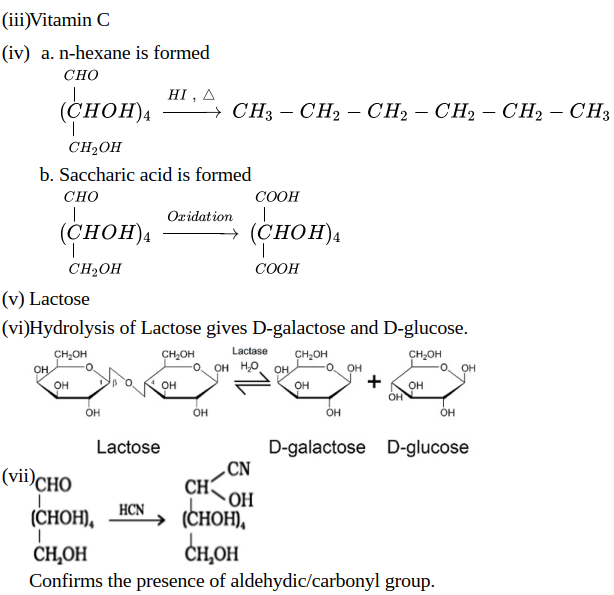
$(d)$ What happens when $D-$glucose is treated with the following? Give equations to support your answer.
$a. HI$
$b. HNO_3$
$(e) $Name the disaccharide which on hydrolysis gives glucose and galactose.
$(f)$ Write the products obtained after hydrolysis of lactose.
$(g)$ Give the reaction of glucose with hydrogen cyanide. Presence of which group is confirmed by this reaction?
Answer

Attempt any five of the following:
$(i)$ Native state of protein is the sequence in which the amino acids are linked together with the help of peptide bond.
$(ii) a.$ Polysaccharides contain a large number of monosaccharide units joined together by glycosidic linkages.
$b.$ Sugar $+$ Phosphate $+$ base  Nucleoside linked to a phosphate group.
Image

Need a full question paper?

Generate a complete, print-ready paper with questions like this in minutes — across 16+ boards, with answer keys.

Start Generating Free

Similar questions

  1. Answer the following questions briefly:
  1. What are reducing sugars?
  2. What is meant by denaturation of a protein?
  3. How is oxygen replenished in our atmosphere?
  1. Define enzymes.
Using crystal field theory, draw energy level diagram, write the electronic configuration of the central metal atom/ion and determine the magnetic moment value in the following:
i. $\left[ CoF _6\right]^{3-},\left[ Co \left( H _2 O \right)_6\right]^{2+},\left[ Co ( CN )_6\right]^{3-}$
ii. $\left[ FeF _6\right]^{3-},\left[ Fe \left( H _2 O \right)_6\right]^{2+},\left[ Fe ( CN )_6\right]^{4-}$
An aromatic compound $'A\ ’$ on treatment with $\ce{CHCl_3/ KOH}$ gives two compounds $'B\ ’$ and $'C\ ’.$ Both $B$ and $C$ give the same product $'D\ ’$ when distilled with zinc dust. Oxidation of $D$ gives $E$ having molecular formula $\ce{C_7H_6O_2}.$ The sodium salt of $E$ on heating with sodalime gives $F$ which may also be obtained by distilling $A$ with zinc dust. Identify $A$ to $F.$
During nuclear explosion, one of the products is 90Sr with half-life of 28.1 years. If $1 \mu g$ of 90Sr was absorbed in the bones of a newly born baby instead of calcium, how much of it will remain after 10 years and 60 years if it is not lost metabolically.
In a reaction between A and B, the inital rate of reaction (ro) was measured for different initial concentrations of A and B as given below :
$A / mol ^{-1}$0.200.200.40
$B / mol L ^{-1}$0.300.100.05
$r _0 / mol L ^{-1} s^{-1}$$5.07 \times 10^{-5}$$5.07 \times 10^{-5}$$1.43 \times 10^{-4}$
What is the order of the reaction with respect to A and B?
Write the $S _{ N } 2$ mechanism of bimolecular nucleophilic substitution.
Describe the structure of CsCl.
Discuss biological and industrial importance of osmosis.
i. Give reasons :
a. Although $- \ce{NH2}$ group is o/p directing in electrophilic substitution reactions, yet aniline, on nitration gives good yield of $m-$nitroaniline.
b. $(\ce{CH 3)2NH}$ is more basic than $(\ce{CH3)3N}$ in an aqueous solution.
c. Ammonolysis of alkyl halides is not a good method to prepare pure primary amines.
ii. Distinguish between the following:
a. $\ce{CH 3 CH 2 NH 2}$ and $(\ce{CH 3 CH 2)2NH}$
b. Aniline and $\ce{CH3NH2}$
  1. Define the terms osmosis and osmotic pressure. Is the osmotic pressure of a solution a colligative property? Explain.
  2. Calculate the boiling point of a solution prepared by adding $15.00 g$ of $\ce{NaCl}$ to $250.0 g$ of water. $(K_b$ for water $= 0.512 K \ kg mol^{–1},$ Molar mass of $\ce{NaCl = 58.44 g)}$