Question
Balance the following ionic equations.
$\text{MnO}^-_4+\text{H}^++\text{Br}^-\xrightarrow{ \ \ \ \ \ \ \ \ }\text{Mn}^{2+}+\text{Br}_2+\text{H}_2\text{O}$
Answer


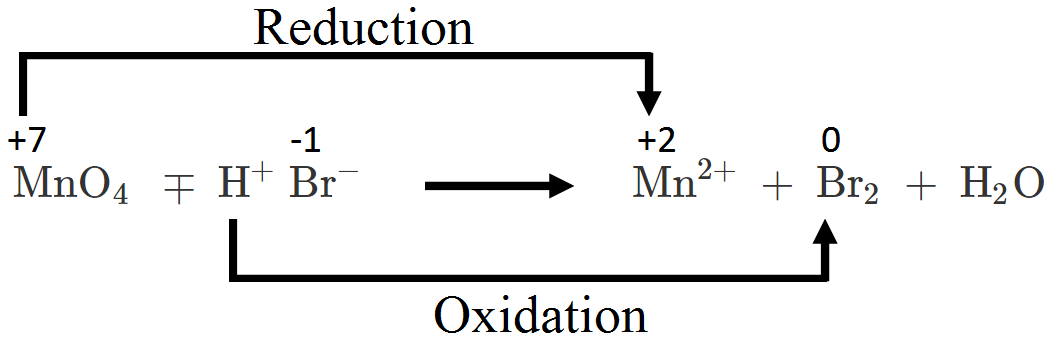
Dividing the equation into two half reactions:
Oxidation half reaction: $\text{Br}^-\xrightarrow{ \ \ \ \ \ \ \ \ }\text{Br}_2$
Reduction half reaction: $\text{MnO}^-_4\xrightarrow{ \ \ \ \ \ \ \ \ }\text{Mn}^{2+}$
Balancing oxidation and reduction half reactions separately as:
Oxidation half reaction
$\text{Br}^-\xrightarrow{ \ \ \ \ \ \ \ \ }\text{Br}_2$
$2\text{Br}^-\xrightarrow{ \ \ \ \ \ \ \ \ \ }\text{Br}_2$
$2\text{Br}^-\xrightarrow{ \ \ \ \ \ \ \ \ }\text{Br}_2+2\text{e}^-...(\text{i})$
Reduction half reaction
$\text{MnO}^-_4\xrightarrow{ \ \ \ \ \ \ \ }\text{Mn}^{2+}$
$\text{MnO}^-_4+5\text{e}^-\xrightarrow{ \ \ \ \ \ \ \ \ }\text{Mn}^{2+}$
$\text{MnO}^-_4+8\text{H}^++5\text{e}^-\xrightarrow{ \ \ \ \ \ \ \ }\text{Mn}^{2+}$
$\text{MnO}^-_4+8\text{H}^++5\text{e}^-\xrightarrow{ \ \ \ \ \ \ \ \ }\text{Mn}^{2+}+4\text{H}_2\text{O}...(\text{ii})$
To balance the electrons, multiply eq. (i) by 5 and eq. (ii) by 2 and add
$2\text{MnO}^-_4+10\text{Br}^-+16\text{H}^+\xrightarrow{ \ \ \ \ \ \ \ \ }2\text{Mn}^{2+}+5\text{Br}_2+8\text{H}_2\text{O}$

Need a full question paper?

Generate a complete, print-ready paper with questions like this in minutes — across 16+ boards, with answer keys.

Start Generating Free

Similar questions

What is meant by entropy? Predict the sign of entropy change in each of the following:
  1. H2 (at 298K, 1atm) → H(at 298K, 10atm)
  2. H2O (at 298K, 1atm) → H­2O (at 330K, 1atm)
  3. 2NH4NO3(s) → 2N2(g) + 4H2O(g) + O2(8)
  4. Crystallization of copper sulphate from its saturated solution.
  5. $2\text{SO}_2(\text{g})+\text{O}_2(\text{g})\rightleftharpoons2\text{SO}_3(\text{g}).$
Which of the following compounds are aromatic according to Huckel's rule?

In a hydrogen atom, the energy of an electron in first Bohr's orbit is $E _{ n }=-\frac{2 \pi^2 me ^4}{ n ^2 h^2}$.
What is the energy required for its excitation to Bohr's second orbit?
How do atomic radius vary in a period and in a group? How do you explain the variation?
For the reaction,
2Cl(g) → Cl2(g), what are the signs of $\Delta\text{H}$ and $\Delta\text{S}?$
Which of the two: O2NCH2CH2O- or CH3CH2O- is expected to be more stable and why?
An ion with mass number 37 possesses one unit of negative charge. If the ion conatins 11.1% more neutrons than the electrons, find the symbol of the ion.
For the following bond cleavages, use curved-arrows to show the electron flow and classify each as homolysis or heterolysis. Identify reactive intermediate produced as free radical, carbocation and carbanion.

If ice and water are in equilibrium at $0^{\circ} C$ then $\Delta H =6.0 kJ mol ^{-1}$. Find value of $\Delta S$ and $\Delta G$.
Calculate the molarity of a solution of ethanol in water, in which the mole fraction of ethanol is 0.040 (assume the density of water to be one).
