Question
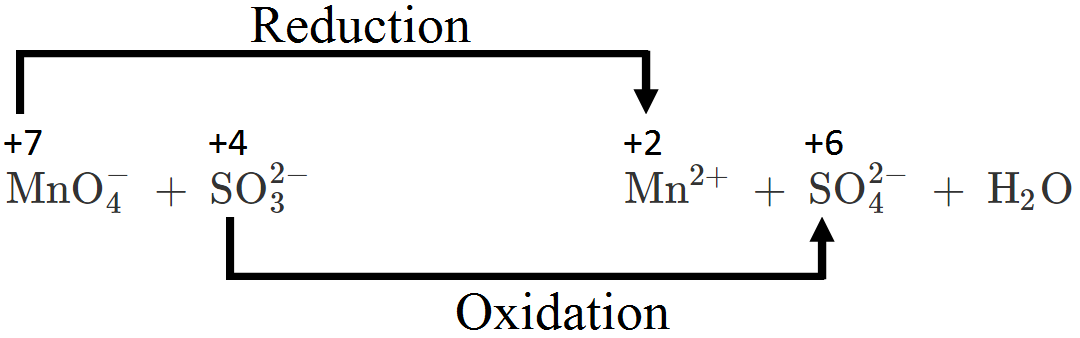
Balance the following ionic equations. $\text{MnO}^{-}_4+\text{SO}^{2-}_3+\text{H}^+\xrightarrow{ \ \ \ \ \ \ \ \ \ }\text{Mn}^{2+}+\text{SO}^{2-}_4+\text{H}_2\text{O}$
Answer


Dividing the equation into two half reactions:
Oxidation half reaction: $\text{SO}^{2-}_3\xrightarrow{ \ \ \ \ \ \ \ }\text{SO}^{2-}_4$
Reduction half reaction: $\text{MnO}^-_4\xrightarrow{ \ \ \ \ \ \ \ }\text{Mn}^{2+}$
Balancing oxidation and reduction half reactions separately as:
Oxidation half reaction
$\text{SO}^{2-}_3\xrightarrow{ \ \ \ \ \ \ \ }\text{SO}^{2-}_4$
$\text{SO}^{2-}_3\xrightarrow{ \ \ \ \ \ \ \ \ \ }\text{SO}^{2-}_4+2\text{e}^{-}$
Since the reaction occurs in acidic medium,
$\text{SO}^{2-}_3\xrightarrow{ \ \ \ \ \ \ \ \ }\text{SO}^{2-}_4+2\text{e}^-+2\text{H}^+$
$\text{SO}^{2-}_3+\text{H}_2\text{O}\xrightarrow{ \ \ \ \ \ \ \ }\text{SO}^{2-}_4+2\text{H}^++2\text{e}^-...\text{(i)}$
Reduction half reaction
$\text{MnO}^-_4\xrightarrow{ \ \ \ \ \ \ \ }\text{Mn}^{2+}$
$\text{MnO}^-_4+5\text{e}^-\xrightarrow{ \ \ \ \ \ \ \ \ }\text{Mn}^{2+}$
$\text{MnO}^-_4+8\text{H}^++5\text{e}^-\xrightarrow{ \ \ \ \ \ \ \ }\text{Mn}^{2+}+4\text{H}_2\text{O}...(\text{ii})$
To balance the electrons, multiply eq. (i) by 5 and eq. (ii) by 2 and add
$2\text{MnO}^-_4+5\text{SO}^{2-}_3+6\text{H}^+\xrightarrow{ \ \ \ \ \ \ \ }2\text{Mn}^{2+}5\text{SO}^{2-}_4+3\text{H}_2\text{O}$

Need a full question paper?

Generate a complete, print-ready paper with questions like this in minutes — across 16+ boards, with answer keys.

Start Generating Free

Similar questions

Explain with reasons the increasing order of energy of different orbitals in multielectron atoms.
Explain various methods of formation of alkynes.
Describe two important uses of each of the following:
  1. Caustic soda.
  2. Sodium carbonate.
  3. Quicklime.
Choose the correct answer.
The enthalpy of combustion of methane, graphite and dihydrogen at 298 K are, $-890.3 \ kJ \ mol ^{-1}-393.5 \ kJ \ mol { }^{-1}$, and $-285.8 \ kJ \ mol ^{-1}$ respectively. Enthalpy of formation of $CH _{4(g)}$ will be:
What is the equilibrium concentration of each of the substances in the equilibrium when the initial concentration of ICl was 0.78M?
$2\text{ICI (g)}\rightleftharpoons\text{I}_2\text{ (g) + Cl}_2\text{ (g)};\text{ K}_{\text{c}}=0.14$
  1. Define solubility product. Write solubility product expression for $Zr_3(PO_4)_4$.
  2. Calculate the pH of $0.01 M CH_3COOH$ solution. $[K_a(CH_2COOH) = 1.74 \times 10^{-51}$
  3. Explain why NaCl is precipitated when HCl(g) is passed through the saturated solution of NaCl.
Molecular hydrides are classified as electron deficient, electron precise and electron rich compounds. Explain each type with two examples.
The ionization constant of dimethylamine is $5.4 \times 10^{–4}$​​​​​​​. Calculate its degree of ionization in its $0.02M$ solution. What percentage of dimethylamine is ionized if the solution is also $0.1M$ in NaOH?
Predict the products of electrolysis in the following:
An aqueous solution of $CuCl_2$ with platinum electrodes.
How is dihydrogen obtained from:
  1. dilute sulphuric acid.
  2. sodium hydroxide and.
  3. water.
Explain by giving equations.