Question
Balance the following unbalanced equation (in acidic medium) by ion electron method (half reaction method).
$
Mn _{( aq )}^{2+}+ ClO _{3( qq )}^{-} \longrightarrow MnO _{2( s )}+ ClO _{2( aq )}
$
Answer

Step 1: Write imbalanced equation for the redox reaction. Assign oxidation number to all the atoms in reactants and products. Divide the equation into two half equations.

https://pg-data.sgp1.digitaloceanspaces.com/chapter_wise/15982/y30.png" alt="Image" width="300" height="">
Step 2: Balance the atoms except $O$ and $H$ in each half equation. Balance half equations for $O$ atoms by adding $H _2 O$ to the side with less $O$ atoms. $Add 2 H _2 O$ to left side of oxidation half equation and $1 H _2 O$ to the right side of reduction half equation.
Oxidation: $Mn _{(\text {aq) }}^{2+}+2 H _2 O _{(l)} \longrightarrow MnO _{2(s)}$
Reduction: $ClO _{3(\text { (aq) }}^{-} \longrightarrow ClO _{2(\text {(aq) }}+ H _2 O _{(f)}$

Step 3: Balance $H$ atoms by adding $H +$ ions to the side with less $H$. Hence add $4 H ^{+}$ ions to the right side of oxidation half equation and $2 H ^{+}$ions to the left side of reduction half equation.
Oxidation: $Mn _{(\text {(aq) }}^{2+}+2 H _2 O _{(l)} \longrightarrow MnO _2+4 H _{( aq )}^{+}$
Reduction: $ClO _{3( aq )}^{-}+2 H _{( aq )}^{+} \longrightarrow ClO _{2 \text { (aq) }}+ H _2 O _{(l)}$
Step 4: Now add 2 electrons to the right side of oxidation half equation and 1 electron to the left side of reduction half equation to balance the charges.
Oxidation: $Mn _{(\text {(aq) }}^{2+}+2 H _2 O _{(l)} \longrightarrow MnO _{2(s)}+4 H _{( aq )}^{+}+2 e ^{-}$
Reduction: $ClO _{3(\text { (aq) })}^{-}+2 H _{(\text {aq) }}^{+}+ e ^{-} \longrightarrow ClO _{2( aq )}+ H _2 O _{(l)}$
Step 5: Multiply reduction half equation by 2 to equalize number of electrons in two half equations. Then add two half equation.
Oxidation: $Mn _{( aq )}^{2+}+2 H _2 O _{(l)} \longrightarrow MnO _2+4 H _{( aq )}^{+}+2 e ^{-}$
Reduction: $2 ClO _{3(\text { (aq) }}^{-}+4 H _{(\text {aq) }}^{+}+2 e ^{-} \longrightarrow 2 ClO _{2(\text { (aq) }}+2 H _2 O _{(l)}$
Add two half equations:
$Mn _{( aq )}^{2+}+2 ClO _{3( aq )}^{-} \longrightarrow MnO _{2( s )}+2 ClO _{2( aq )}$
The equation is balanced in terms of number of atoms and the charges.
Hence, balanced equation: $Mn _{( aq )}^{2+}+2 ClO _{3( aq )}^{-} \longrightarrow MnO _{2( s )}+2 ClO _{2( aq )}$+

Need a full question paper?

Generate a complete, print-ready paper with questions like this in minutes — across 16+ boards, with answer keys.

Start Generating Free

Similar questions

Explain how equilibrium constant helps in predicting the direction of the reaction.
Urea $[(NH_2)_2CO]$ is prepared by reacting ammonia with carbon dioxide.
$2NH_{3(g)} + CO_{2(g)} \rightarrow (NH_2)_2CO_{(aq)} + H_2O_{(l)}$
In one process, $637.2 g \ of \ NH_3$ are treated with $1142 g \ of \ CO_2.$
$i.$ Which of the two reactants is the limiting reagent?
$ii.$ Calculate the mass of $(NH_2)_2CO$ formed.
$iii.$ How much excess reagent (in grams) is left at the end of the reaction?
The unit of $KC$ is different for different reactions. Explain this statement with suitable examples.
Describe the shape of $2p$ orbitals.
Explain liquid$-$vapour equilibrium with an example.
Balance the following redox equation by oxidation number method. The reactions occur in acidic medium.
$i. \  H _2 O _{2( aq )}+ Cr _2 O _{7( aq )}^{2-} \longrightarrow O _{2( g )}+ Cr _{( mq )}^{3+}$
$ii. \  A g (s)+ N O _{3(\text { (mq) }}^{-} \longrightarrow A g _{(\text {(qq) }}^{+}+ N O _{2( g )}$
$iii. \  Sn _{(\text {(qq) }}^{2+}+ IO _{\text {(teq) }}^{-} \longrightarrow Sn _{( aq )}^{4+}+ I _{(\text {(aq) })}^{-}$
$iv. \  MnO _{4(\text { (q) })}^{-}+ IO _{3(\text { ave }}^{-} \longrightarrow MnO _{2( s )}+ IO _{4( mq )}^{-}$
$v. \  N O _{3( qq )}^{-}+ SO _{2( qq )} \longrightarrow SO _{4( sq )}^{2-}+ NO _{2( g )}$
Differentiate between chemical reactions and nuclear reactions.
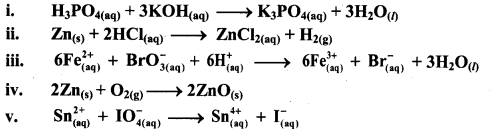
Using oxidation number concept, identify the redox reactions, identify oxidizing and reducing agents in case of redox reactions.
Image
Give the different graphical representations of Boyle’s law.
Explain the formation of water $(H_2O)$ molecule on the basis of hybridization.