MCQ
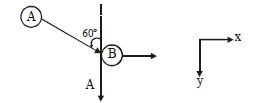
Ball $A$ moving at $12\  m/s$ collides elastically with $B$ as shown. If both balls have the same mass, what is the final velocity of ball $A$ ? ................$m/s$
  • A
    $3$
  • $6$
  • C
    $9$
  • D
    $12$

Answer

Correct option: B.
$6$
b
$\mathrm{mv}_{\mathrm{A}} \cos \theta=\mathrm{mv}^{\prime}_{\mathrm{Ay}}$

$\mathrm{mv}_{\mathrm{A}} \sin \theta=\mathrm{mv}_{\mathrm{Bx}}^{\prime}$

Need a full question paper?

Generate a complete, print-ready paper with questions like this in minutes — across 16+ boards, with answer keys.
Start Generating Free

Similar questions

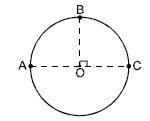
If $\theta$ is angle between the velocity and acceleration of a particle moving on a circular path with decreasing speed, then .........
A steel wire having a radius of $2.0\, mm$, carrying a load of $4\, kg$, is hanging from a ceiling. Given that $g = 3.1\pi \,m{s^{ - 2}}$ , what will be the tensile stress that would be developed in the wire?
The order of the magnitude of speed of light in $SI$ unit is ........ 
A spherical hollow is made in a lead sphere of radius $R,$ such that its surface touches the outside surface of lead sphere and passes through the centre. What is the shift in the centre of mass of lead sphere due to the following ?
At what temperature (in $ ^{\circ} C$) a gold ring of diameter $6.230$ $cm$ be heated so that it can be fitted on a wooden bangle of diameter $6.241 \,cm$ ? Both the diameters have been measured at room temperature $\left(27^{\circ} C \right)$. (Given: coefficient of linear thermal expansion of gold $\alpha_{L}=1.4 \times 10^{-5} \,K ^{-1}$ )
Match List$-I$ with List$-II$

      List $-I$       List $-II$
$(A)$ Moment of inertia of solid sphere of radius $(R)$ about any tangent  $(I)$  $\frac{5}{3} MR ^{2}$
$(B)$ Moment of inertia of hollow sphere of radius $(R)$ about any tangent $(II)$ $\frac{7}{5} MR ^{2}$
$(C)$ Moment of inertia of circular ring of radius $(R)$ about its diameter. $(III)$ $\frac{1}{4} MR ^{2}$
$(D)$ Moment of inertia of circular disc of radius $(R)$ about any diameter. $(IV)$ $\frac{1}{2} MR ^{2}$

Question: Choose the correct answer from the options given below
An area of cross-section of rubber string is $2\,c{m^2}$. Its length is doubled when stretched with a linear force of $2 \times {10^5}$dynes. The Young's modulus of the rubber in $dyne/c{m^2}$ will be
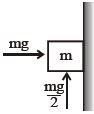
A block pressed against the vertical wall is in equilibrium. The minimum coefficient of  friction is:-
The centripetal acceleration is given by
Three particle $A, B$ and $C$ move in a circle of radius $r = \frac{1}{\pi }\,m$, in anticlockwise direction with speeds $1\, m/s$, $2. 5\, m/s$ and $2\, m/s$ respectively. The initial positions of $A, B$ and $C$ are as shown in figure. The ratio of distance travelled by $B$ and $C$ by the instant $A, B$ and $C$ meet for the first time is