MCQ
Bartholinus discovered:
  • A
    Interference by splitting the wave front
  • B
    Polarisation by reflection
  • C
    Polarisation by refraction
  • Polarisation by double refraction

Answer

Correct option: D.
Polarisation by double refraction

In $1669,$ another Danish scientist, Erasmus Bartholinus discovered the polarization of light by double refraction in Iceland spar $($calcite$).$

Need a full question paper?

Generate a complete, print-ready paper with questions like this in minutes — across 16+ boards, with answer keys.
Start Generating Free

Similar questions

When a dielectric material is introduced between the plates of a charged condenser then electric field between the plates
An equiconvex lens of focal length $f$ is cut into four equal parts and two parts are placed as shown in figure. The focal length of system shown in figure is :-
In a $L-R$ circuit, the value of $L$ is $\left( {\frac{{0.4}}{\pi }} \right)\;henry$ and the value of $R$ is $30\, ohm$. If in the circuit, an alternating e.m.f. of $200\,volt$ at $50$ cycles per sec is connected, the impedance of the circuit and current will be
The permanent magnetic moment of the atoms of a material is not zero. The material:
A body of mass $M$ is kept on a rough horizontal surface $($friction coefficient $= \mu).$ A person is trying to pull the body by applying a horizontal force but the body is not moving. The force by the surface on $A$ is $F,$ where:
Two nucleons are at a separation of $1 \times {10^{ - 15}}m$. The net force between them is ${F_1}$, if both are neutrons, ${F_2}$ if both are protons and ${F_3}$ if one is a proton and other is a neutron. In such a case
If the mass of neutron $=1.7\times 10−27\ kg$ . Then the de broglie wavelength of neutron of energy $3eV$ is:
A cycle wheel contains $24$ spokes of $0.5\, m$ length. It is rotated in horizontal plane  with $120\, revolution/min.$ in the effect of earth magnetic field. If total magnetic field of  earth is $10^4\, G$, then dynamic $emf$ across centre and rim of the wheel (angle of dip is  $30^o$)
A steady current is passing through a linear conductor of non uniform cross$-$section. The net quantity of charge crossing any cross section per second is:
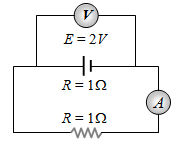
Assertion : In the following circuit emf is 2V and internal resistance of the cell is 1$\Omega$ and R = 1$\Omega$, then reading of the voltmeter is 1V.


Reason : V = E - ir where E = 2V, i = $\frac{2}{2}=1 \mathrm{~A}$ and R = 1 $\Omega$