MCQ
Basicity of $H_3BO_3$ is :
  • $1$
  • B
    $2$
  • C
    $3$
  • D
    $4$

Answer

Correct option: A.
$1$
a
Protic acid is an acid that can undergo ionization and produce hydrogen ions/protons. However, aprotic acids do not produce any hydrogen ions/protons.

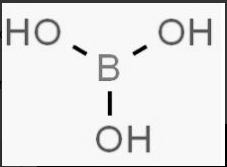
Although Boric acid contains 3 OH groups yet it can act as monobasic acid rather than tribasic acid. This is because boric acid does not act as a proton donor rather it accepts a pair of

electrons from $\mathrm{OH}^{-}$ ions.

It does not donate $\mathrm{H}^{+}$ rather it accepts an electron pair from the solution or the donor i.e. $\mathrm{OH}^{-}$

Thus, Boric acid is an aprotic acid (like lewis acid) and monobasic acid.
Need a full question paper?

Generate a complete, print-ready paper with questions like this in minutes — across 16+ boards, with answer keys.
Start Generating Free

Similar questions

Which one is the complimentary base of adenine in one strand to that in the other strand of DNA?
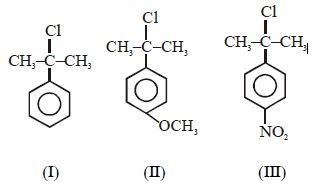
The decreasing order of reactivity of the compound given below towards solvolysis under identical condition is
If for a sucrose solution elevation in boiling point is $0.1\,^o C$  then what will be the boiling point of $NaCl$  solution for same molal concentration  ..........  $^oC$
Which of the following oxide of nitrogen is the anhydride of $HN{O_3}$
Given below are two statements, one is labelled as Assertion $A$ and the other is labelled as Reason $R$

Assertion $A :$- Carbon forms two important oxides $- CO$ and $CO _2 . CO$ is neutral whereas $CO _2$ is acidic in nature.

Reason $R :$- $CO _2$ can combine with water in a limited way to form carbonic acid, while $CO$ is sparingly soluble in water.

In the light of the above statements, choose the most appropriate answer from the options given below :-

Which of the following species is most reactive in ${{S}_{{{N}^{2}}}}$  reaction ?
Which of the following is an amphoteric acid
$pH$ of a salt solution of wak acid $\left( pK _{ a }=4\right)$ \&weak base $\left( pK _{ b }=5\right)$ at $25^{\circ} C$ is:
For the reactions

$A\, \rightleftharpoons \,B$                     ${K_C} = 2$

$B\, \rightleftharpoons \,C$                    ${K_C} = 3$

$C\, \rightleftharpoons \,D+E$               ${K_C} = 5$

$K_C$ for the reaction $A\, \rightleftharpoons \,D+E$ is

Which one of the following is the correct decreasing order of boiling point