Question
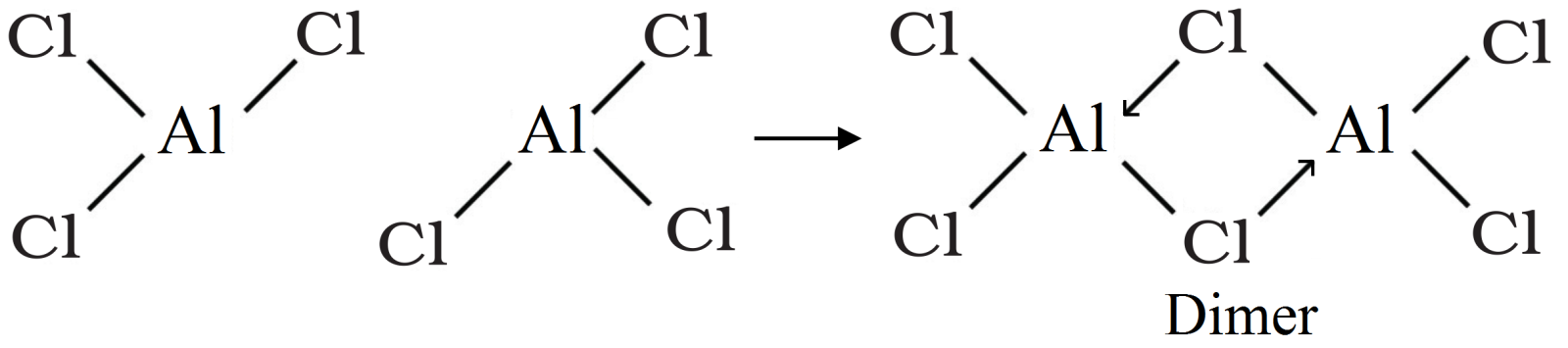
$\mathrm{BCl}_3$ exists as monomer whereas $\mathrm{AlCl}_3$ is dimerised through halogen bridging. Give reason. Explain the structure of the dimer of $\mathrm{AlCl}_3$ also.
Answer

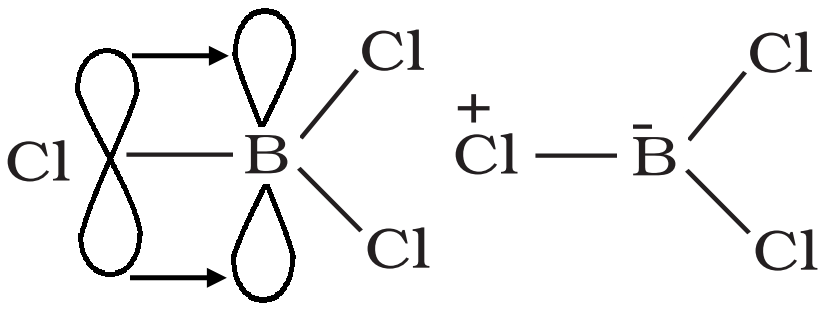
$\mathrm{BCl}_3$ exists as monomer in spite of the fact that it is an electron deficient compound. It achieves stability by forming $p \pi$ - $\mathrm{p} \pi$ back bonding. Chlorine transfers two electrons to vacant $2 p$-orbital of boron. All the three bond lengths are same. Thus, the back

bonding giving double bond character is delocalized in the molecule. $\mathrm{AlCl}_3$ is also an electron deficient compound. Since, aluminium has larger size than boron, the back bonding is not possible in $\mathrm{AlCl}_3$. Aluminium metal complete its octet by forming coordinate bond with chlorine atom of the other molecule, $\mathrm{AlCl}_3$. Thus, coordinate bond forming bridges by chlorine atoms between two Al atoms make a dimer molecule.

Need a full question paper?

Generate a complete, print-ready paper with questions like this in minutes — across 16+ boards, with answer keys.

Start Generating Free

Similar questions

What happens when (i) magnesium is burnt in air (ii) quick lime is heated with silica (iii) chlorine reacts with slaked lime (iv) calcium nitrate is heated?
$2.9g$ of a gas at $95^\circ C$ occupied the same volume as $0.184g$ of dihydrogen at $17^\circ C$, at the same pressure. What is the molar mass of the gas?
Draw the cis and trans structures of hex-2-ene. Which isomer will have higher b.p. and why?
1. During estimation of nitrogen present in an organic compound by Kjeldahl's method, the ammonia evolved from 0.5 g of the compound in Kjeldahl's estimation of nitrogen, neutralized 10 mL of $1 M H _2 SO _4$. Find out the percentage of nitrogen in the compound.
2. Explain why $\left( CH _3\right)_3 \stackrel{+}{ C }$ is more stable than $CH _3 \stackrel{+}{ C } H _2$ and $\stackrel{+}{ C } H _3$ is the least stable cation.
Explain the following reactions: Silicon is heated with methyl chloride at high temperature in the presence of copper.
How do you account for the strong reducing power of lithium in aqueous solution?
Explain with examples the terms necessary to determine the pH of weak electrolyte solution.
Explain the following :
(a) isomerisation of alkanes
(b) aromaticity
(c) thermal decomposition
  1. Write the conjugate acid for Bronsted base of $HCOO^-$.
  2. Calculate the pH of a $1.0 \times 10^{-8}$ M solution of HCl.
  3. Calculate the solubility of $A_2X_3$ in pure water, assuming that neither kind of ion reacts with water. [The solubility product of $A_2X_3, K_{sp} = 1.1 \times 10^{-23}$]
Write the mechanism of reaction of propene and HBr in presence of peroxide.