MCQ
Beats are the result of
  • A
    Diffraction
  • B
    Destructive interference
  • C
    Constructive and destructive interference
  • Superposition of two waves of nearly equal frequency

Answer

Correct option: D.
Superposition of two waves of nearly equal frequency
d
(d) Beats is the superposition of two waves of nearly equal frequencies. When the two tones are close in pitch but not identical, the difference in frequency generates the beating The volume varies like in a tremolo as the sounds alternately interfere constructively and destructively.

Need a full question paper?

Generate a complete, print-ready paper with questions like this in minutes — across 16+ boards, with answer keys.

Start Generating Free

Similar questions

A projectile projected at an angle ${30^o}$ from the horizontal has a range $2\upsilon ,\,\sqrt 2 \upsilon \,\,{\rm{ and}}\,{\rm{zero}}$. If the angle of projection at the same initial velocity be ${60^o}$, then the range will be
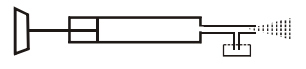
A spray gun is shown in the figure where a piston pushes air out of a nozzle. A thin tube of uniform cross section is connected to the nozzle. The other end of the tube is in a small liquid container. As the piston pushes air through the nozzle, the liquid from the container rises into the nozzle and is sprayed out. For the spray gun shown, the radii of the piston and the nozzle are $20 \ mm$ and $1 \ mm$ respectively. The upper end of the container is open to the atmosphere. $Image$

$1.$ If the piston is pushed at a speed of $5 \ mms ^{-1}$, the air comes out of the nozzle with a speed of

$(A)$ $0.1 \ ms ^{-1}$ $(B)$ $1 \ ms ^{-1}$ $(C)$ $2 \ ms ^{-1}$ $(D)$ $8 \ ms ^{-1}$

$2.$ If the density of air is $\rho_{ a }$ and that of the liquid $\rho_{\ell}$, then for a given piston speed the rate (volume per unit time) at which the liquid is sprayed will be proportional to

$(A)$ $\sqrt{\frac{\rho_{ a }}{\rho_{\ell}}}$ $(B)$ $\sqrt{\rho_a \rho_{\ell}}$ $(C)$ $\sqrt{\frac{\rho_{\ell}}{\rho_{ a }}}$ $(D)$ $\rho_{\ell}$

Give the answer question $1$ and $2.$
The motion of a particle along a straight line is described by equation $x = 8 + 12t - t^3$ where $x$ is in metre and $t$ in second. The retardation of the particle when its velocity becomes zero is...........$m/s^2$
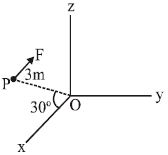
A force $F\, = 2.0\,N$ acts on a particle $P$ in the $xz-$ plane. The force $F$ is parallel to $x-$ axis. The particle $P$ (as shown in the figure) is at a distance $3\,m$ and the line joining $P$ with the origin make angle $30^o$ with the $x-$ axis. The magnitude of torque on $P$ with respect to origin $O(in N-m)$ is
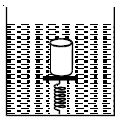
A cylindrical block of area of cross-section $A$ and of material of density $\rho$ is placed in a liquid of density one-third of density of block. The block compresses a spring and compression in the spring is one-third of the length of the block. If acceleration due to gravity is $g$, the spring constant of the spring is:
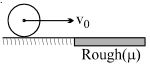
$A$ ring of mass $M$ and radius $R$ sliding with a velocity $v_0$ suddenly enters into rough surface where the coefficient of friction is $\mu$ , as shown in figure. Choose the correct statement $(s)$
The mass and volume of a body are $4.237g$ and $2.5 \mathrm{~cm}^3$, respectively. The density of the material of the body in correct significant figures is:
A ball of mass m falls vertically to the ground from a height$ h_1$ and rebound to a height ${h_2}$. The change in momentum of the ball on striking the ground is
Which of the following quantities does not depend upon the orbital radius of the satellite.
Force constant of a spring is $K$ . If half part is detached then force constant of the remaining spring will be