The previous statement describes the essence of which theory?
- ANewton's law of universal gravitation
- BChaos theory
- CRelativity
- DQuantum Theory
Explanation:
The statement has the essence of quantum theory which postulates that both the position and momentum cannot be precisely measured at the same instant. This is called Uncertainty Principle. An associated error always exists in either or both. Hence behavior of complex systems becomes much more difficult to analyse and impossible to predict.
Generate a complete, print-ready paper with questions like this in minutes — across 16+ boards, with answer keys.
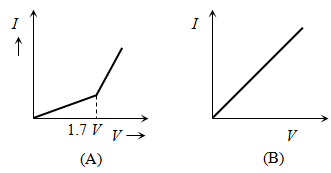
The V-i graphs A and B drawn for two voltameters. Identify each graph

|
(a) A for water voltameter and B for Cu voltameter |
|
(b) A for Cu voltameter and B for water voltameter |
|
(c) Both A and B represents Cu voltameter |
|
(d) None of these |
In the circuit shown below, The reading of the voltmeter V is
|
(a) 12 V |
(b) 8 V |
(c) 20 V |
(d) 16 V |
There is a uniform electric field of strength along y-axis. A body of mass 1g and charge
is projected into the field from origin along the positive x-axis with a velocity 10m/s. Its speed in m/s after 10s is (Neglect gravitation)
|
(a) 10 |
(b) 5 |
(c) 10 |
(d) 20 |
When 2 amperes current is passed through a tangent galvanometer, it gives a deflection of 30o. For 60o deflection, the current must be
|
(a) 1 amp |
(b) 2 |
(c) 4 amp |
(d) 6 amp |
A lens (focal length 50 cm) forms the image of a distant object which subtends an angle of 1 milliradian at the lens. What is the size of the image
|
(a) 5 mm |
(b) 1 mm |
(c) 0.5 mm |
(d) 0.1 mm |
The two waves represented by y1 = a sin(wt) and have a phase difference of
|
(a) 0 |
(b) |
(c) |
(d) |
Assertion : Zener diode works on a principle of breakdown voltage.
Reason : Current increases suddenly after breakdown voltage.
|
(a) If both assertion and reason are true and the reason is the correct explanation of the assertion. |
|
(b) If both assertion and reason are true but reason is not the correct explanation of the assertion. |
|
(c) If assertion is true but reason is false. |
|
(d) If the assertion and reason both are false. |
Which of the following electromagnetic waves have minimum frequency
|
(a) Microwaves |
(b) Audible waves |
(c) Ultrasonic waves |
(d) Radiowaves |