Question
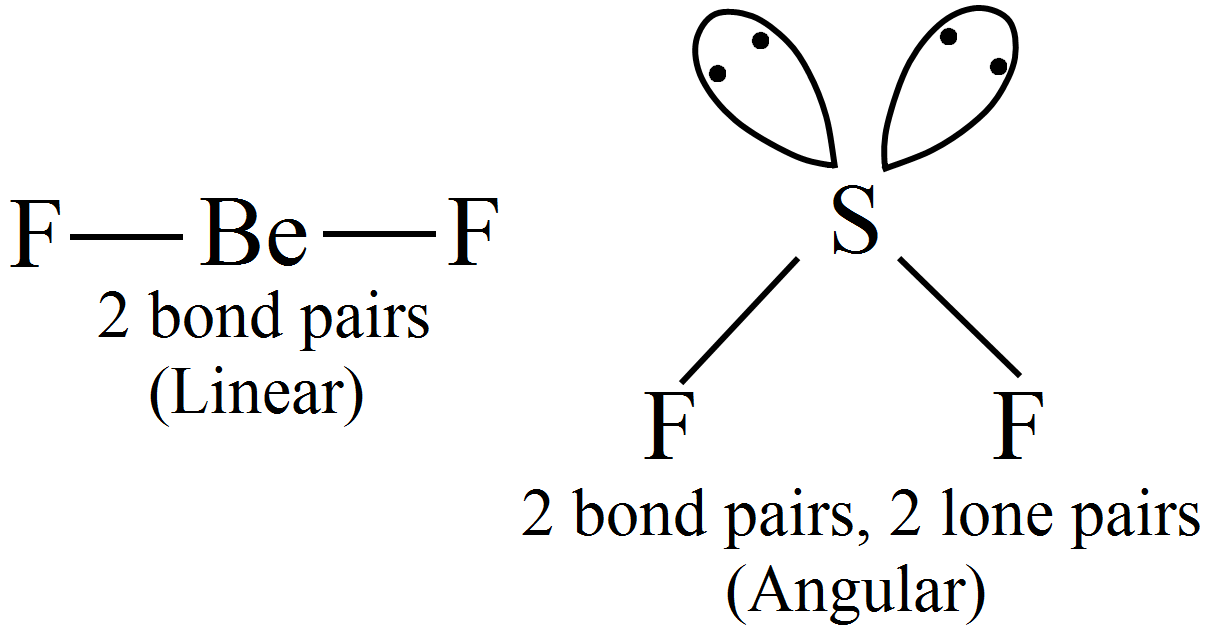
BeF2 molecule is linear while SF2 is angular through both are triatomic?
Answer

In BeF2, Be is the central atom and is surrounded by 2 bond pairs only therefore, the molecule is linear. On the other hand, in SF2, the central atom S is surrounded by 2 bond pairs and 2 lone pairs. Since at is surrounded by 4 electron pairs, the geometry is expected to be tetrahedral with two position occupied by lone pairs.

Need a full question paper?

Generate a complete, print-ready paper with questions like this in minutes — across 16+ boards, with answer keys.

Start Generating Free

Similar questions

Balance the following redox reactions by ion-electron method:

MnO4-(aq) + SO2(g) → Mn2+(aq) + HSO4-(aq) (in acidic solution).

  1. How can one non-polar molecule induce a dipole in a nearby non-polar molecule?
  2. Write the molecular orbital configurations of the following species:
  1. $\text{O}^-_2$

  2. $\text{C}_2.$

Calculate their bond order.

Equal volumes of 0.002 M solutions of sodium iodate and cupric chlorate are mixed together. Will it lead to precipitation of copper iodate? (For cupric iodate $K_{s p}=7.4 \times 10^{-8}$ )
Calculate the weight of FeO formed from 2g of VO and 5.75g of Fe2O3. Also, report the limiting reagent.
2VO + 3Fe2O3 → 6FeO + V2O5
(Atomic mass of V = 51.4, O = 16, Fe = 55.9g)
The ionization constant of dimethylamine is $5.4 \times 10^{-4}$. Calculate its degree of ionization in its 0.02 M solution. What percentage of dimethylamine is ionized if the solution is also 0.1 M in NaOH ?
The diameter of zinc atom is 2.6 $\mathring{\text{A}}$.Calculate,
  1. Radius of zinc atom in pm
  2. Number of atoms present in a length of 1.6cm if the zinc atoms are arranged side by side lengthwise.
1. Use the following reactions to arrange the elements $A , B , C$ and D in order of their redox reactivity
a. $A + B ^{+} \rightarrow A ^{+}+ B$
b. $B + D ^{+} \rightarrow B ^{+}+ D$
c. $C ^{+}+ D \rightarrow$ No reaction
d. $B + C ^{+} \rightarrow B ^{+}+ C$
2. On the basis of above redox activity series, predict which of the following reactions would you expect to occur?
a. $A ^{+}+ C \rightarrow A + C ^{+}$
b. $A ^{+}+ D \rightarrow A + D ^{+}$
Consider the reactions:

O3(g) + H2O2(l) → H2O(l) + 2O2(g)

Why it is more appropriate to write these reactions as:

O3(g) + H2O2(l) → H2O(l) + O2(g) + O2(g)

Also suggest a technique to investigate the path of the above redox reactions.

How many grams of KClO3 must be decomposed to prepare 3.36 litres of oxygen at STP? (Atomic weight of K = 39, Cl= 35.5, 0 = 16u)
Chlorophyll present in green leaves of plants absorbs light at 4.620 × 10¹⁴Hz. Calculate the wavelength of radiation in nanometer. Which part of the electromagnetic spectrum does it belong to?