MCQ
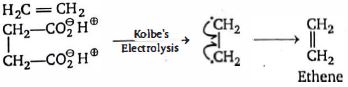
$\begin{array}{*{20}{c}}
  {C{H_2} - C{O_2}K} \\ 
  {|\,\,\,\,\,\,\,\,\,\,\,\,\,\,\,\,\,\,\,\,\,\,\,\,\,\,} \\ 
  {C{H_2} - C{O_2}K} 
\end{array}\xrightarrow{{electrolysis}}\mathop {(A)}\limits_{\left( {major} \right)} $ (Kolbe electrolysis method)

Product $(A)$ of the reaction is 

  • A
    $CH_3 - CH_3$
  • $CH_2 = CH_2$
  • C
    $CH_3 -CH = CH_2$
  • D
    none of these

Answer

Correct option: B.
$CH_2 = CH_2$
b

Need a full question paper?

Generate a complete, print-ready paper with questions like this in minutes — across 16+ boards, with answer keys.

Start Generating Free

Similar questions

$STATEMENT-1$: For every chemical reaction at equilibrium, standard Gibbs energy of reaction is zero. and $STATEMENT-2$: At constant temperature and pressure, chemical reactions are spontaneous in the direction of decreasing Gibbs energy.
In the following electron dot structure, correct calculation of the formal charge from left to right nitrogen atom is $\overset{\,\,\,\centerdot \,\,\centerdot \,\,\,\,\,\,\,\,\,\,\,\,\,\,\,\,\,\,\,\,\,\,}{\mathop{:N=N=}}\,\overset{\centerdot \,\,\centerdot }{\mathop{N}}\,:$
A reaction attains equilibrium when the free energy change accompanying it is
$100\, \mathrm{~mL}$ of $\mathrm{Na}_{3} \mathrm{PO}_{4}$ solution contains $3.45\, \mathrm{~g}$ of sodium. The molarity of the solution is $.....\times 10^{-2}$ $\operatorname{mol} \,\mathrm{L}^{-1} \cdot($ Nearest integer $)$

[Atomic Masses - $\mathrm{Na}: 23.0\, \mathrm{u}, \mathrm{O}: 16.0\, \mathrm{u}, \mathrm{P}: 31.0 \,\mathrm{u}]$

An electrolyte
How many number of compounds, which have same $IUPAC$ name ?
Assign $A, B, C, D$ from given type of reaction. ${H_3}P{O_3}\xrightarrow{\Delta }{H_3}P{O_4} + P{H_3} \uparrow $
$5\,\,mole$  of an ideal gas expand isothermally and irreversibly from a pressure of $10\,\,atm$  to $1\,\,atm$ aganist a constant external pressure of $1\,\,atm.$  $w_{irr}$ at $300\,\,K$  is
The difference between the mass number and the atomic number gives the _______.
SO2​ + O​⇌ 2SO3​ + Heat
The equilibrium reaction proceeds in forward direction by: