MCQ
$\begin{array}{*{20}{c}}
  {C{H_3} - CH - CH = C{H_2}} \\ 
  {|\,\,\,\,\,\,\,\,\,\,\,\,\,\,\,\,\,\,\,\,} \\ 
  {C{H_3}\,\,\,\,\,\,\,\,\,\,\,\,\,\,} 
\end{array}$ $\xrightarrow{{{\text{D}}Br}}\,Product \,\left( {Major} \right)$ Product will be
  • A
    $\begin{array}{*{20}{c}}
      {Br\,\,\,\,\,\,\,\,\,\,\,} \\ 
      {|\,\,\,\,\,\,\,\,\,\,\,\,\,} \\ 
      {C{H_3} - C - CH - C{H_3}} \\ 
      {\,|\,\,\,\,\,\,\,\,\,|\,\,\,\,\,} \\ 
      {C{H_3}\,D\,\,\,\,} 
    \end{array}$
  • B
    $\begin{array}{*{20}{c}}
      {\,\,\,\,\,\,\,\,\,\,\,\,\,\,\,\,\,\,\,\,\,\,\,\,Br\,\,\,\,\,\,\,\,D\,} \\ 
      {\,\,\,\,\,\,\,\,\,\,\,\,\,\,\,\,\,\,\,\,\,\,\,\,\,\,\,\,\,\,|\,\,\,\,\,\,\,\,\,\,\,\,\,\,|\,\,\,\,\,\,\,} \\ 
      {C{H_3} - CH - CH - C{H_2}} \\ 
      {\,|\,\,\,\,\,\,\,\,\,\,\,\,\,\,\,\,\,\,\,} \\ 
      {C{H_3}\,\,\,\,\,\,\,\,\,\,} 
    \end{array}$
  • $\begin{array}{*{20}{c}}
      {Br\,\,\,\,\,\,\,\,\,\,\,\,\,\,\,} \\ 
      {|\,\,\,\,\,\,\,\,\,\,\,\,\,\,\,\,\,\,\,} \\ 
      {C{H_3} - C - C{H_2} - C{H_2}D} \\ 
      {\,|\,\,\,\,\,\,\,\,\,\,\,\,\,\,\,\,\,\,\,} \\ 
      {C{H_3}\,\,\,\,\,\,\,\,\,\,\,} 
    \end{array}$
  • D
    $\begin{array}{*{20}{c}}
      {\,\,Br\,\,\,\,\,\,\,\,\,D\,\,\,\,\,\,\,\,\,\,\,\,\,\,\,\,\,\,\,\,\,\,\,\,\,\,\,\,\,\,\,\,} \\ 
      {|\,\,\,\,\,\,\,\,\,\,\,\,\,\,\,\,|\,\,\,\,\,\,\,\,\,\,\,\,\,\,\,\,\,\,\,\,\,\,\,\,\,\,\,\,\,\,\,} \\ 
      {C{H_2} - C - C{H_2} - C{H_3}} \\ 
      {|\,\,\,\,\,\,\,\,\,\,\,\,\,\,\,\,} \\ 
      {C{H_3}\,\,\,\,\,\,\,\,\,\,} 
    \end{array}$
Answer

Correct option: C.
$\begin{array}{*{20}{c}}
  {Br\,\,\,\,\,\,\,\,\,\,\,\,\,\,\,} \\ 
  {|\,\,\,\,\,\,\,\,\,\,\,\,\,\,\,\,\,\,\,} \\ 
  {C{H_3} - C - C{H_2} - C{H_2}D} \\ 
  {\,|\,\,\,\,\,\,\,\,\,\,\,\,\,\,\,\,\,\,\,} \\ 
  {C{H_3}\,\,\,\,\,\,\,\,\,\,\,} 
\end{array}$
c

Need a full question paper?

Generate a complete, print-ready paper with questions like this in minutes — across 16+ boards, with answer keys.

Start Generating Free

Similar questions

The de-Broglie wavelength of a particle of mass $6.63\,g$ moving with a velocity of $100\,ms^{-1}$ is
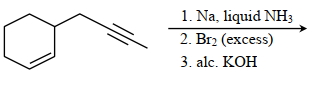
The number of isomeric tetraenes (NOT containing $s p$-hybridized carbon atoms) that can be formed from the following reaction sequence is. . . . . . 
$0.01\, M\, KMnO _{4}$ solution was added to $20.0\, mL$ of $0.05\, M$ Mohr's salt solution through a burette. The initial reading of $50\, mL$ burette is zero. The volume of $KMnO _{4}$ solution left in the burette after the end point is $.....\,mL$. (nearest integer)
Boron form covalent compound due to
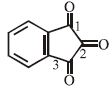
Which carbonyl group is most reactive for $NAR$ ?
Which of the following expression is correct for a reversible process in a state of equilibrium?
The exothermic formation of $ClF_3$ is represented by the equation

$C{l_{2\left( g \right)}} + 3{F_2}_{\left( g \right)} \rightleftharpoons 2C{l_3}_{\left( g \right)};\Delta {H_r} =  - 329\,kJ$ 

Which of the following will increase the quantity of $ClF_3$ in an equilibrium mixture of $Cl_2, F_2$ and $ClF_3$ ?

Which of the following is the most stable compound
Experiment shows that ${H_2}O$ has a dipole moment while $C{O_2}$ has not. Point out the structures which best illustrate these facts
Principle functional group in given compound is

$\begin{array}{*{20}{c}}
  {{H_3}C - C - O - C - C{H_2} - O - C{H_3}} \\ 
  {||\,\,\,\,\,\,\,\,\,\,\,\,\,\,\,\,\,\,\,\,||\,\,\,\,\,\,\,\,\,\,\,\,\,\,\,\,\,\,\,\,\,\,\,\,\,\,\,\,\,\,} \\ 
  {O\,\,\,\,\,\,\,\,\,\,\,\,\,\,\,\,\,\,\,O\,\,\,\,\,\,\,\,\,\,\,\,\,\,\,\,\,\,\,\,\,\,\,\,\,\,\,\,\,\,\,} 
\end{array}$