MCQ
$\begin{array}{*{20}{c}}
  {C{H_3} - C{H_2} - CH - C{H_3}\xrightarrow[{KOH}]{{Alc.}}\mathop X\limits_{\left( {{\text{major}}} \right)} \,;} \\ 
  {\,\,\,\,\,\,\,\,\,\,\,\,|\,\,\,\,\,\,\,\,\,\,\,\,\,\,\,\,\,\,\,\,\,\,\,\,\,\,\,\,\,\,\,} \\ 
  {\,\,\,\,\,\,\,\,\,\,\,\,\,Br\,\,\,\,\,\,\,\,\,\,\,\,\,\,\,\,\,\,\,\,\,\,\,\,\,\,\,\,\,} 
\end{array}\,$

$\begin{array}{*{20}{c}}
  {C{H_3} - C{H_2} - CH - C{H_3}\xrightarrow[\Delta ]{{EtoNa}}\mathop {{\text{ }}Y}\limits_{\left( {{\text{major}}} \right)} } \\ 
  {{\mkern 1mu} {\mkern 1mu} {\mkern 1mu} {\mkern 1mu} {\mkern 1mu} {\mkern 1mu} {\mkern 1mu} {\mkern 1mu} {\mkern 1mu} {\mkern 1mu} {\mkern 1mu} {\mkern 1mu} |{\mkern 1mu} {\mkern 1mu} {\mkern 1mu} {\mkern 1mu} {\mkern 1mu} {\mkern 1mu} \,\,\,\,\,{\mkern 1mu} \,\,\,\,{\mkern 1mu} {\mkern 1mu} {\mkern 1mu} {\mkern 1mu} {\mkern 1mu} {\mkern 1mu} {\mkern 1mu} {\mkern 1mu} {\mkern 1mu} {\mkern 1mu} {\mkern 1mu} {\mkern 1mu} {\mkern 1mu} {\mkern 1mu} {\mkern 1mu} {\mkern 1mu} {\mkern 1mu} {\mkern 1mu} {\mkern 1mu} {\mkern 1mu} {\mkern 1mu} {\mkern 1mu} {\mkern 1mu} {\mkern 1mu} } \\ 
  {{\mkern 1mu} {\mkern 1mu} {\mkern 1mu} \mathop {{\mkern 1mu} {\mkern 1mu} {\mkern 1mu} {\mkern 1mu} \,\,\,\,\,\,\,NM{e_3}\,\,\,\,\,\,\,{\mkern 1mu} }\limits_{\,\,\,\,\,\,\,\,\,\, \oplus \,\,\,\,\,\,\,\,\,\,\,\,\,\,\,\,\,\,\,\,} {\mkern 1mu} {\mkern 1mu} {\mkern 1mu} {\mkern 1mu} {\mkern 1mu} {\mkern 1mu} {\mkern 1mu} {\mkern 1mu} {\mkern 1mu} {\mkern 1mu} {\mkern 1mu} {\mkern 1mu} {\mkern 1mu} {\mkern 1mu} } 
\end{array}{\mkern 1mu} $

Product $(X)$ and $(Y)$ respectively is

  • A
    $1-$ butene, trans $2-$ butene
  • B
    $1-$ butene, cis $-2-$ butene
  • C
    cis $-2-$ butene, $1-$ butene
  •  trans $2-$ butene, $1-$ butene

Answer

Correct option: D.
 trans $2-$ butene, $1-$ butene
d

Need a full question paper?

Generate a complete, print-ready paper with questions like this in minutes — across 16+ boards, with answer keys.

Start Generating Free

Similar questions

$Be$ and $Al$ have following resemblance due to the diagonal relationship:
.
Which of the following compounds is optically active
The solubility product $(K_{sp})$ of the following compounds are given at $25\,^oC$

Compound $K_{sp}$
$AgCl$ $1.1\times10^{-10}$
$AgI$ $1.0\times10^{-16}$
$PbCrO_4$ $4.0\times10^{-14}$
$Ag_2CO_3$ $8.0\times10^{-12}$

The most soluble and least soluble compounds are respectively.

The molar solubility of $Cd(OH)_2$ is $1.84\times10^{-5}\, M$ in water. The expected solubility of $Cd(OH)_2$ in a buffer solution of $pH = 12$ is
Number of alkanes obtained on electrolysis of a mixture of $\mathrm{CH}_3 \mathrm{COONa}$ and $\mathrm{C}_2 \mathrm{H}_5 \mathrm{COONa}$ is_____.
Find out the value of $K_C$ for the following reaction from the value of $K_P$

$2NOCl\left( g \right) \rightleftharpoons 2NO\left( g \right) + C{l_2}\left( g \right)$

Given : $K_P = 8 \times 10^{12}\, atm$ at $500\, K$ use $R = 0.08\, L\, atm\, mol^{-1}\, K^{-1}$

Enthalpy change for a reaction does not depend upon
Consider the following reaction sequence

$\begin{array}{*{20}{c}}
  {\,\,C{H_3}\,\,\,\,\,\,\,\,\,\,\,} \\ 
  {|\,\,\,\,\,\,\,\,\,\,\,\,\,\,\,\,} \\ 
  {C{H_3} - C - CH = C{H_2}} \\ 
  {|\,\,\,\,\,\,\,\,\,\,\,\,\,\,\,\,} \\ 
  {\,\,C{H_3}\,\,\,\,\,\,\,\,\,\,\,} 
\end{array}\xrightarrow[{2.\,KOH - EtOH,\,heat}]{{1.\,HBr}}$

The major end product formed is :-

Consider the following compounds in the liquid form :

$O _2, HF , H _2 O , NH _3, H _2 O _2, CCl _4, CHCl _3, C _6 H _6, C _6 H _5 Cl \text {. }$

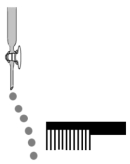
When a charged comb is brought near their flowing stream, how many of them show deflection as per the following figure?