MCQ
$\begin{array}{*{20}{c}}
  {O\,\,\,\,\,\,\,\,\,\,\,\,\,\,} \\ 
  {||\,\,\,\,\,\,\,\,\,\,\,\,\,\,\,} \\ 
  {C{H_3} - C - O - {C_2}{H_5}} 
\end{array}$ $\xrightarrow{{{H_2}N - N{H_2}}}X$;  $\begin{array}{*{20}{c}}
  {\,\,\,\,\,\,\,O\,\,\,\,\,\,\,\,\,\,} \\ 
  {\,\,\,\,\,\,\,\,||\,\,\,\,\,\,\,\,\,\,\,} \\ 
  {C{H_3} - C - {C_2}{H_5}} 
\end{array}$ $\xrightarrow{{{H_2}N - N{H_2}}}Y$

$X$ and $Y$ are

  • A
    $X=$ $\begin{array}{*{20}{c}}
      {C{H_3} - C - O{C_2}{H_5}} \\ 
      {||\,\,\,\,\,\,\,\,\,\,} \\ 
      {\,\,\,\,\,\,\,\,\,\,\,N - N{H_2}} 
    \end{array}$, $Y =$ $\begin{matrix}
       C{{H}_{3}}-C-{{C}_{2}}{{H}_{5}}  \\
       \,\,\,\,\,\,\,||\,\,\,\,\,\,\,\,\,\,  \\
       \,\,\,\,\,\,\,\,\,\,\,\,\,\,\,N-N{{H}_{2}}  \\
    \end{matrix}$
  • B
    $X =$ $\begin{matrix}
       C{{H}_{3}}-C-N{{H}_{2}}  \\
       ||  \\
       \,\,O  \\
    \end{matrix}$, $Y= $ $\begin{matrix}
       C{{H}_{3}}-C-{{C}_{2}}{{H}_{5}}  \\
       \,\,\,\,\,\,\,||\,\,\,\,\,\,\,\,\,\,  \\
       \,\,\,\,\,\,\,\,\,\,\,\,\,\,\,N-N{{H}_{2}}  \\
    \end{matrix}$
  • $X =$ $\begin{matrix}
       C{{H}_{3}}-C-NH-N{{H}_{2}}  \\
       ||\,\,\,\,\,\,\,\,\,\,\,\,\,\,\,\,  \\
       O\,\,\,\,\,\,\,\,\,\,\,\,\,\,\,\,  \\
    \end{matrix}$, $Y =$ $\begin{matrix}
       C{{H}_{3}}-C-{{C}_{2}}{{H}_{5}}  \\
       \,\,\,\,\,\,\,||\,\,\,\,\,\,\,\,\,\,  \\
       \,\,\,\,\,\,\,\,\,\,\,\,\,\,\,N-N{{H}_{2}}  \\
    \end{matrix}$
  • D
    $X =$ $\begin{matrix}
       C{{H}_{3}}-C-{{C}_{2}}{{H}_{5}}  \\
       \,\,\,\,\,\,\,||\,\,\,\,\,\,\,\,\,\,  \\
       \,\,\,\,\,\,\,\,\,\,\,\,\,\,\,N-N{{H}_{2}}  \\
    \end{matrix}$, $Y = $ $\begin{matrix}
       C{{H}_{3}}-C-{{C}_{2}}{{H}_{5}}  \\
       \,\,\,\,\,\,\,||\,\,\,\,\,\,\,\,\,\,  \\
       \,\,\,\,\,\,\,\,\,\,\,\,\,\,\,N-N{{H}_{2}}  \\
    \end{matrix}$

Answer

Correct option: C.
$X =$ $\begin{matrix}
   C{{H}_{3}}-C-NH-N{{H}_{2}}  \\
   ||\,\,\,\,\,\,\,\,\,\,\,\,\,\,\,\,  \\
   O\,\,\,\,\,\,\,\,\,\,\,\,\,\,\,\,  \\
\end{matrix}$, $Y =$ $\begin{matrix}
   C{{H}_{3}}-C-{{C}_{2}}{{H}_{5}}  \\
   \,\,\,\,\,\,\,||\,\,\,\,\,\,\,\,\,\,  \\
   \,\,\,\,\,\,\,\,\,\,\,\,\,\,\,N-N{{H}_{2}}  \\
\end{matrix}$
c

Need a full question paper?

Generate a complete, print-ready paper with questions like this in minutes — across 16+ boards, with answer keys.

Start Generating Free

Similar questions

The half-life period of a first order reaction is $15\,minutes$. The amount of substance left after one hour will be
For the given first order reaction $\text { A } \rightarrow \text { B }$ the half life of the reaction is $0.3010\,min$. The ratio of the initial concentration of reactant to the concentration of reactant at time $2.0\,min$ will be equal to $........$ (Nearest integer)
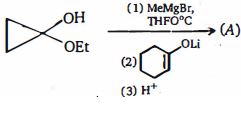
Product $(A)$ in this sequence is
$\begin{array}{*{20}{c}}
  {C{H_3}\,\,\,\,} \\ 
  {|\,\,\,\,\,\,\,\,\,\,\,\,} \\ 
  {C{H_3} - C - O - C{H_3}} \\ 
  {\,\,|\,\,\,\,\,\,\,\,\,\,\,\,\,\,} \\ 
  {C{H_3}\,\,\,} 
\end{array}$ $\xrightarrow[{\left( {Cold} \right)}]{{HI}}$ Product is
$2-$ pentanone can be distinguished from $3-$ pentanone by the reagent
Consider the following reactions :

$(i)$ $PCl_3 + 3H_2O \to H_3PO_3 + 3HCl$   

$(ii)$ $SF_4 + 3H_2O \to H_3SO_3 + 4HF$   

$(iii)$ $BCI_3 + 3H_2O \to H_3BO_3 + 3HCl$   

$(IV)$ $XeF_6 + 3H_2O \to XeO_3 + 6HF$

Then according to given information the incorrect statement is

Aniline reacts with mixed acid (conc. $HNO _3$ and conc. $H _2 SO _4$ ) at $288 K$ to give $P (51 \%)$,

$Q (47 \%)$ and $R (2 \%)$. The major product(s) of the following reaction sequence is (are)

$\begin{array}{l}\begin{array}{ll}\text { 1) } Ac _2 O \text {, pyridine } \quad \text { 1) } Sn / HCl \end{array} \\ R \xrightarrow{2) Br _2, CH _3 CO _2 H } S \quad \xrightarrow{2) Br _2 / H _2 O \text { (excess) }} \text { major product(s) } \\ \text { 3) } H _3 O ^{+} \quad \text {3) } NaNO _2, HCl / 273-278 K \\ \text { 4) } NaNO _2, HCl / 273-278 K \quad  \text { 4) } H _3 PO _2 \\ \text { 5) } EtOH , \Delta \\\end{array}$

The complex $[Pt{(N{H_3})_6}]C{l_4}$ furnishes .......  ions
In an ${{S}_{{{N}^{1}}}}$ reaction on chiral centres, there is
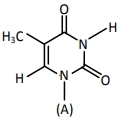
The compound $'A'$ is a complementary base of in $DNA$ stands.