MCQ
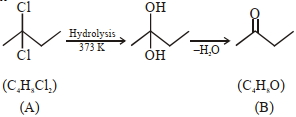
$ \begin{array}{c} A \\ \left(C_{4} H_{8} C l_{2}\right) \end{array} $ ${\xrightarrow{ Hydrolysis \;at \;373 \;K }}$ $ \begin{array}{c} B \\ \left(C_{4} H_{8} O\right) \end{array} $

$B$ reacts with Hydroxyl amine but does not give Tollen's test. Identify $A$ and $B$

  • A
    $1,1 -$Dichlorobutane and $2 -$Butanone
  • B
    $2,2-$Dichlorobutane and Butanal
  • C
    $1,1 -$Dichlorobutane and Butanal
  • $2,2 -$Dichlorobutane and $2 -$butan-one
Answer

Correct option: D.
$2,2 -$Dichlorobutane and $2 -$butan-one
d

Need a full question paper?

Generate a complete, print-ready paper with questions like this in minutes — across 16+ boards, with answer keys.

Start Generating Free

Similar questions

Dehydrohalogenation in monohaloalkanes produces
Which of the following is correct structure of $L$ -alanine ?
Arrange reactivity of given alcohol in increasing order of elimination reaction

$(I)$ $\begin{array}{*{20}{c}}
  {C{H_2} - C{H_2} - C{H_2} - C{H_2}OH} \\ 
  {|\,\,\,\,\,\,\,\,\,\,\,\,\,\,\,\,\,\,\,\,\,\,\,\,\,\,\,\,\,\,\,\,\,\,\,\,\,\,\,\,\,\,\,\,\,\,\,\,\,\,\,\,\,\,} \\ 
  {N{O_2}\,\,\,\,\,\,\,\,\,\,\,\,\,\,\,\,\,\,\,\,\,\,\,\,\,\,\,\,\,\,\,\,\,\,\,\,\,\,\,\,\,\,\,\,\,\,\,\,\,} 
\end{array}$

$(II)$ $\begin{array}{*{20}{c}}
  {C{H_3} - C{H_2} - CH - C{H_2}OH} \\ 
  {|\,} \\ 
  {N{O_2}} 
\end{array}$

$(III)$ $\begin{array}{*{20}{c}}
  {C{H_3} - CH - C{H_2} - C{H_2}OH} \\ 
  {|\,\,\,\,\,\,\,\,\,\,\,\,\,\,\,\,\,\,\,\,\,\,\,\,\,\,\,} \\ 
  {N{O_2}\,\,\,\,\,\,\,\,\,\,\,\,\,\,\,\,\,\,\,\,\,\,\,} 
\end{array}$

$(IV)$ $CH_3-CH_2-CH_2-CH_2OH$

Select answer from codes given below :

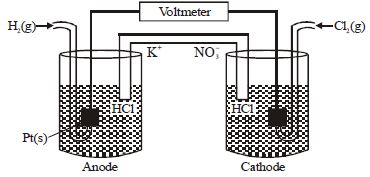
Consider the following Galvanic cell (Image) By what value the cell voltage change when concentration of ions in anodic and cathodic compartments both increased by factor of $10$ at $298\, K.$
On strong heating, ammonium acetate gives
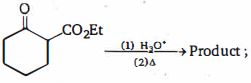
Product of the reaction is
The reagents that can be used to convert benzenediazonium chloride to benzene are __________.
The half-life of $C _{14}$ is 5760 years. After how many years will a 100 mg sample of ${ }^6 C _{14}$ be reduced to 25 mg ?
If rate law is $r = K[A]$ then left conc of reactant after time $t = 1/k $ is :- $([A]_0 -$ concentration of reactant at $t = 0)$
Consider the reaction

$(i)\,\,(CH_3)_2CH-CH_2Br \xrightarrow{{{C_2}{H_5}OH}} (CH_3)_2CH-CH_2OC_2H_5 + HBr$

$(ii)\,\,(CH_3)_2CH-CH_2-Br \xrightarrow{{{C_2}{H_5}{O^- }}} (CH_3)_2CH-CH_2OC_2H_5 + Br^-$

The mechanisms of reaction $(i)$ and $(ii)$ are respectively