MCQ
Below conversion can be brought about by ?
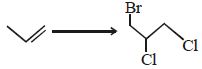
- A$(i)$ $HBr$ ; $(ii)$ $Cl_2$
- B$(i)$ $Cl_2 $ ; $(ii)$ $NBS$
- ✓$(i)$ $NBS$ ; $(ii)$ $Cl_2$
- D$(i)$ $Cl_2$ ; $(ii)$ $BrCl / CCl_4$

Generate a complete, print-ready paper with questions like this in minutes — across 16+ boards, with answer keys.
What will be the electrode potential at $pH = 3$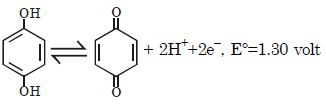
$Q + Cl ^{-} \rightarrow X$
$Q + Me _3 N \rightarrow Y$
$Q + CuCl _2 \rightarrow Z + CuCl$
$X$ is a monoanion having pyramidal geometry. Both $Y$ and $Z$ are neutral compounds. Choose the correct option($s$).
$(1)$ The central atoms in $X$ is $sp ^3$ hybridized
$(2)$ The oxidation state of the central atom in $Z$ is $+2$
$(3)$ The central atom in $Z$ has one lone pair of electrons
$(4)$ There is a coordinate bond in $Y$
| List I (Complex) | List $II$ (Type of isomerism) |
| $A$. $\left[\mathrm{Co}\left(\mathrm{NH}_3\right)_5\left(\mathrm{NO}_2\right)\right] \mathrm{Cl}_2$ | $I$. Solvate isomerism |
| $B$. $\left[\mathrm{Co}\left(\mathrm{NH}_3\right)_5\left(\mathrm{SO}_4\right)\right] \mathrm{Br}$ | $II$. Linkage isomerism |
| $C$. $\left[\mathrm{Co}\left(\mathrm{NH}_3\right)_6\right]\left[\mathrm{Cr}(\mathrm{CN})_6\right]$ | $III$. Ionization isomerism |
| $D$. $\left[\mathrm{Co}\left(\mathrm{H}_2 \mathrm{O}\right)_6\right] \mathrm{Cl}_3$ | $IV$. Coordination isomerism |
Choose the correct answer from the options given below:
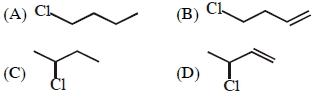
${{C}_{2}}{{H}_{5}}O{{C}_{2}}{{H}_{5}}+4[H]\xrightarrow{\text{Red P}+\text{HI}}2X+{{H}_{2}}O,$ $X$ is