MCQ
Below figures $(1)$ and $(2)$ represent lines of force. Which is correct statement
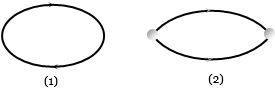
  • Figure $(1)$ represents magnetic lines of force
  • B
    Figure $(2)$ represents magnetic lines of force
  • C
    Figure $(1)$ represents electric lines of force
  • D
    Both figure $(1)$ and figure $(2)$ represent magnetic lines of force
Answer

Correct option: A.
Figure $(1)$ represents magnetic lines of force
a
(a) Magnetic lines of force always makes a closed loop.

Need a full question paper?

Generate a complete, print-ready paper with questions like this in minutes — across 16+ boards, with answer keys.

Start Generating Free

Similar questions

In a triode valve the amplification factor is $20$ and mutual conductance is $10^{-3}$ mho. The plate resistance is
A presbyopic patient has near point as $30\, cm$ and far points as $40\, cm$. The dioptric power for the corrective lens for seeing distant objects is
A light ray incident on a surface of refractive index $n$, which is separating this medium from air. The angle of incidence is $45^{\circ}$. For what value of $n$ can this ray have total internal reflection?
A coil of 100 turns and area 5 square centimetre is placed in a magnetic field B = 0.2 T. The normal to the plane of the coil makes an angle of 60° with the direction of the magnetic field. The magnetic flux linked with the coil is
Two point sources X and Y emit waves of same frequency and speed but Y lags in phase behind X by 2pl radian. If there is a maximum in direction D the distance XO using n as an integer is given by
A star is moving towards the earth with a speed of $4.5 \times 10^6 m / s$. If the true wavelength of a certain line in the spectrum received from the star is $5890 \mathring A$, its apparent wavelength will be about $\left[ c =3 \times 10^8 m / s ^{]}\right.$
A long thin hollow metallic cylinder of radius 'R' has a current i ampere. The magnetic induction 'B'-away from the axis at a distance r from the axis varies as shown in
The resistance of a wire is $5 \Omega$. It's new resistance in ohm if stretched to $5$ times of it's original length will be :
While doing his experiment, Millikan one day observed the following charges on a single drop
(i) $6.563 \times 10^{-19}C$ (ii) $8.204 \times 10^{-19}C$ (iii) $11.50 \times 10^{-19}C$ (iv) $13.13 \times 10^{-19}C$ (v) $16.48 \times 10^{-19}C$ (vi) $18.09 \times 10^{-19}C$
From this data the value of the elementary charge (e) was found to be 
If $n$ represents the actual number of deflections in a converted galvanometer of resistance $G$ and shunt resistance $S$. Then the total current I when its figure of merit is $K$ will be