MCQ
Benzoic acid undergoes dimerisation in benzene solution. The van't Hoff factor $(i)$ is related to the degree of association ' $x^{\prime}$ of the acid as
- A$i=(1-x)$
- B$i=(1+x)$
- C$i=\left(1-\frac{x}{2}\right)$
- ✓$i=\left(1+\frac{x}{2}\right)$
So $m =\frac{0.5}{74.6} \times \frac{1}{0.1}$
$\Delta T _{ f }= i \times m _{ f }$
$0.24=i \cdot \frac{0.5}{74.6} \times \frac{1.80}{0.1}$
$i=\frac{0.24 \times 74.6}{0.5 \times 1.80} \times 0.1$
$=1.989$
$1.989=1+\alpha( n -1)$
$1.989=1+\alpha$
$\alpha=.989$
$\% \alpha=98.9 \%$
Ans $99 \,\%$
If mass of $H _{2} O =99.5$
$m =\frac{0.5}{74.5} \times \frac{1}{.0995}$
$i =\frac{0.24 \times 74.6 \times .0995}{.5 \times 1.80}$
$=1.979$
$1.979=1+\alpha( n -1)$
$1.979=1+\alpha$
$\alpha=.979$
$\% \alpha=97.9\, \%$
$98\, \%$
Generate a complete, print-ready paper with questions like this in minutes — across 16+ boards, with answer keys.
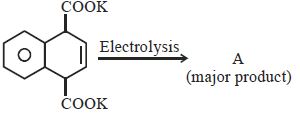
The following inferences are made
$(A)$ $\mathrm{X}$ has higher intermolecular interactions compared to $Y$.
$(B)$ $\mathrm{X}$ has lower intermolecular interactions compared to $Y$.
$(C)$ $\mathrm{Z}$ has lower intermolecular interactions compared to $Y.$
The correct inference(s) is/are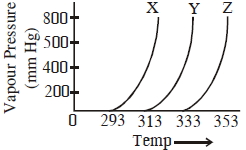
$(a)$ Peroxide ion as well as dioxygen molecule both are paramagnetic species
$(b)$ In set of isomers, $[Cr(H_2O)_6]Cl_3$ and $[CrCl(H_2O) _5]Cl_2 . H_2O,$ both compounds can easily loose water molecule on treatment with cone. $H_2SO_4$
$(c)$ During transformation $NO \to NO^+$ , bond length and magnetic behaviour decreases
$(d)$ An ether is more volatile than alcohol both having same molecular formula