MCQ
Beryllium and aluminum exhibit many properties which are similar. But the two elements differ in :
  • Maximum covalency in compounds
  • B
    Exhibiting amphoteric nature in their oxides
  • C
    Forming covalent halides
  • D
    Forming polymeric hydrides

Answer

Correct option: A.
Maximum covalency in compounds
Be exhibits maximum covalency of four whereas $Al$ shows maximum covalency of six.

Need a full question paper?

Generate a complete, print-ready paper with questions like this in minutes — across 16+ boards, with answer keys.

Start Generating Free

Similar questions

Covalent bond can undergo fission in two different ways. The correct representation involving a heterolytic fission of $\ce{CH_3—Br}$ is :
An organic compound has an empirical formula $C{H_2}O$, its vapour density is $45$. The molecular formula of the compounds is
Which of the following statements is incorrect?
The solution of sulphuric acid contains $80\%$ by weight ${H_2}S{O_4}$. Specific gravity of this solution is $1.71$. Its normality is about
Assertion : Energy of resonance hybrid is equal to the average of energies of all canonical forms.

Reason : Resonance hybrid cannot be presented by a single structure.

Cyclopentadiene is much more acidic than cyclopentane. The reason is that
Mendeleev's left the gap nder aluminium and a gap under silicon having atomic weights $68$ and $72$ respectively. These elements respectively are :
Assuming the bond direction to the $z$ -axis, which of the overlapping of atomic  orbitals of two atom $(A)$ and $(B)$ will result in bonding?

$(I)\, s-$ orbital of $A$ and $P_x$ -orbital of $B$

$(II)\, s-$ orbital of $A$ and $P_z$ orbital of $B$

$(Ill)\, p_y$ -orbital of $A$ and $p_z$ orbital of $B$

$(IV)\, s-$ orbital of both $(A)$ and $(B)$

In the given molecule $(NC)_3 CCCCHCHBr$ number of $\sigma $ and $\pi -$ bonds respectively are
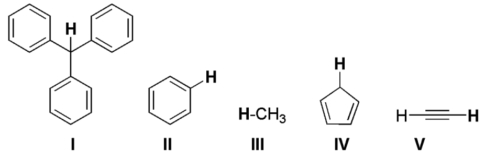
With respect to the compounds $I-V$, choose the correct statement($s$).

$(A)$ The acidity of compound $I$ is due to delocalization in the conjugate base.

$(B)$ The conjugate base of compound IV is aromatic.

$(C)$ Compound II becomes more acidic, when it has a $- NO _2$ substituent.

$(D)$ The acidity of compounds follows the order $I > IV > V > II > III$.