MCQ
$BiC{l_3}$ on hydrolysis forms a white precipitate of
  • A
    Bismuth acid
  • Bismuth oxychloride
  • C
    Bismuth pentachloride
  • D
    Bismuth hydroxide

Answer

Correct option: B.
Bismuth oxychloride
b
(b)$BiC{l_3} + {H_2}O\, \to \,BiOCl + 2HCl$

Need a full question paper?

Generate a complete, print-ready paper with questions like this in minutes — across 16+ boards, with answer keys.

Start Generating Free

Similar questions

The noble gases have closed-shell electronic configuration and are monoatomic gases under normal conditions. The low boiling points of the lighter noble gases are due to weak dispersion forces between the atoms and the absence of other interatomic interactions.

The direct reaction of xenon with fluorine leads to a series of compounds with oxidation numbers $+2,+4$ and $+6$ . XeF $4$ reacts violently with water to give $\mathrm{XeO}_3$. The compounds of xenon exhibit rich stereochemistry and their geometries can be deduced considering the total number of electron pairs in the valence shell.

$1.$ Argon is used in arc welding because of its

$(A)$ low reactivity with metal 

$(B)$ ability to lower the melting point of metal

$(C)$ flammability 

$(D)$ high calorific value

$2.$  The structure of $\mathrm{XeO}_3$ is

$(A)$ linear  $(B)$ planar  $(C)$ pyramidal  $(D)$ $T$-shaped

$3.$  $\mathrm{XeF}_4$ and $\mathrm{XeF}_6$ are expected to be

$(A)$ oxidizing  $(B)$ reducing  $(C)$ unreactive  $(D)$ strongly basic

Give the answer question $1,2$ and $3.$
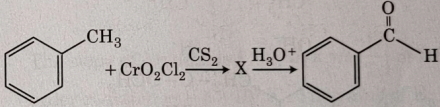
The intermediate compound $'\mathrm{X}'$ in the following chemical reaction is :
Which of the following statements is not correct regarding $NO_2$ molecule
Which does not give isocyanide test ?
Spin only magnetic moment of an octahedral complex of $\mathrm{Fe}^{2+}$ in the presence of a strong field ligand in $B.M.$ is $.....$
Which of the following can react with $K _{2} Cr _{2} O _{7}$
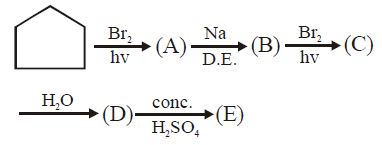
Identify $'E'$ (major) product ?
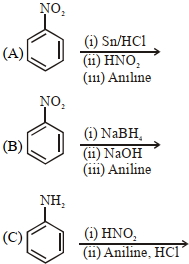
Which of the following reaction/s will not give $p-$aminoazobenzene ?

${image}$

Calculate the amount of water evaporated if $2.8\ kg$ of $2\ m\ CaBr_2$ solution is heated to $110\,^o\ C$ at $1\ atm$ .......... $gm$

(Given : $K_b$ of water $=0.5\ Kkg/mol$ . ; Atomic mass of $Ca =40$ , $Br =80$)
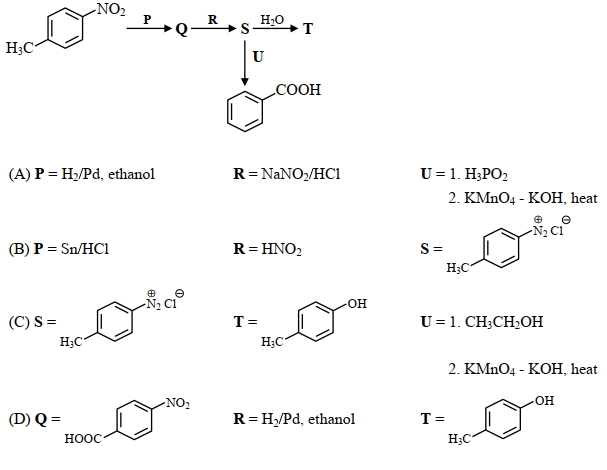
Consider the following reaction sequence,