MCQ
Blasting of $TNT$ is done by mixing
  • A
    $N{H_4}Cl$
  • $N{H_4}N{O_3}$
  • C
    $N{H_4}N{O_2}$
  • D
    ${(N{H_4})_2}S{O_4}$

Answer

Correct option: B.
$N{H_4}N{O_3}$
b
$TNT$ forms an highly explosive material with nitrate, called amatol.

Need a full question paper?

Generate a complete, print-ready paper with questions like this in minutes — across 16+ boards, with answer keys.

Start Generating Free

Similar questions

Match List-I with List-$II$

List-$I$

(Complexion)

List-$II$

(Spin only magnetic

moment in B.M.)

$A$ ${\left[\mathrm{Cr}\left(\mathrm{NH}_5\right)_0\right]^{3+}}$ $I$ $4.90$
$B$ ${\left[\mathrm{NiCl}_4\right]^{2-}}$ $II$ $3.87$
$C$ ${\left[\mathrm{CoF}_6\right]^{3-}}$ $III$ $0.0$
$D$ ${\left[\mathrm{Ni}(\mathrm{CN})_4\right]^{2-}}$ $IV$ $2.83$

Choose the correct answer from the options given below:

Which of the following complex has zero magnetic moment (spin only)?
After ozonolysis of benzene (not hydrolysis), the product is
Consider 

The correct order of their acidity is 

$HOCH_2·CH_2OH$ on heating with periodic acid gives
Covalent electron deficient hydride is formed by
Presence of which reagent will affect the reversibility of the following reaction, and change it to a irreversible reaction:

$\mathrm{CH}_{4}+\mathrm{I}_{2} \underset{\text { Reversible }}{\stackrel{\mathrm{hv}}{\longrightarrow}} \mathrm{CH}_{3}-\mathrm{I}+\mathrm{HI}$ 
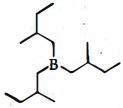
Which of the following compound would yield trialkylborane shown below when  treated with $BH_3/THF$?
The electron affinities of halogens are $F = 322$, $Cl = 349$, $Br = 324$, $I = 295\,kJ\,mo{l^{ - 1}}$. The higher value for $Cl$ as compared to that of $F$ is due to
The conductance of a $0.0015 \mathrm{M}$ aqueous solution of a weak monobasic acid was determined by using a conductivity cell consisting of platinized $\mathrm{Pt}$ electrodes. The distance between the electrodes is $120 \mathrm{~cm}$ with an area of cross section of $1 \mathrm{~cm}^2$. The conductance of this solution was found to be $5 \times 10^{-7} \mathrm{~S}$. The $\mathrm{pH}$ of the solution is $4$ . The value of limiting molar conductivity $\left(\Lambda_{\mathrm{m}}^0\right)$ of this weak monobasic acid in aqueous solution is $\mathrm{Z} \times 10^2 \mathrm{~S} \mathrm{~cm}^{-1} \mathrm{~mol}^{-1}$. The value of $\mathrm{Z}$ is