MCQ
Blood calcium level can be increased by the administration of
  • A
    Glucogon
  • B
    Calcitonin
  • C
    Thyroxine
  • Paratharmone

Answer

Correct option: D.
Paratharmone
d
$A$. Glucagon is secreted from alpha cells of islets of Langerhans of pancreas. It increases blood sugar level by stimulating glycogenolysis (i.e. break down of glucose) and gluconeogenesis (synthesis of glucose).

$B.$ Thyroxine is secreted from thyroid gland. It stimulates the consumption of oxygen by metabolically active tissues and also increases the oxidation of glucose in tissues.

$C.$ Parathormone is secreted from parathyroid gland and increases calcium reabsorption from the bones and causes mobilisation of calcium in the blood.

$D.$ Calcitonin is secreted from the $C-$cells of thyroid gland and acts on bone and kidneys to reduce blood calcium level. Hence, blood calcium level is increased by parathormone. So, the correct answer is $'Parathormone'$.

Need a full question paper?

Generate a complete, print-ready paper with questions like this in minutes — across 16+ boards, with answer keys.

Start Generating Free

Similar questions

For reaction $2 A \rightarrow 3 B$ what is the reaction rate $-\frac{d(A)}{d t}$ equals to?
Assertion : Alpha $\left( \alpha  \right) - $ amino acids exist as internal salt in solution as they have amino and carboxylic acid groups in near vicinity.
Reason : $H^+$ ion given by carboxylic group $(-COOH)$ is captured by amino group $(-NH_2)$ having lone pair of electrons.
Chloropicrin is a strong lachrymatory compound and is used in war. It is prepared by
Hydrolysis of acetamide produces
In a mixture of $A$ and $B$ components show positive deviation when
Consider the following single step reaction in gas phase at constant temperature.

$2 \mathrm{~A}_{(\mathrm{g})}+\mathrm{B}_{(\mathrm{g})} \rightarrow \mathrm{C}_{(\mathrm{g})}$

The initial rate of the reaction is recorded as $r_1$ when the reaction starts with $1.5 \mathrm{~atm}$ pressure of $\mathrm{A}$ and $0.7 \mathrm{~atm}$ pressure of B. After some time, the rate $r_2$ is recorded when the pressure of $C$ becomes $0.5 \mathrm{~atm}$. The ratio $r_1: r_2$ is $\qquad$ $\times 10^{-1}$.

(Nearest integer)
$\begin{array}{*{20}{c}}
  {\,\,\,\,\,\,\,\,\,O\,\,\,\,\,\,\,\,\,\,\,\,\,\,\,\,\,\,\,\,\,\,\,\,\,\,\,\,\,\,\,\,\,\,\,\,\,\,\,\,\,\,\,\,\,\,O} \\ 
  {\,\,\,\,\,\,\,\,||\,\,\,\,\,\,\,\,\,\,\,\,\,\,\,\,\,\,\,\,\,\,\,\,\,\,\,\,\,\,\,\,\,\,\,\,\,\,\,\,\,\,\,\,\,\,\,\,||} \\ 
  {C{H_3} - C - C{H_2} - C{H_2} - C - H} 
\end{array}$ $\xrightarrow[\Delta ]{{NaOH}}$ Product
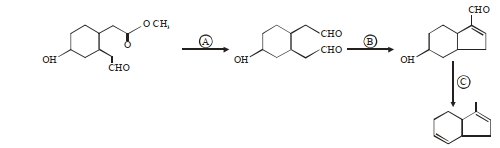
Identify the reagents used for the following conversion
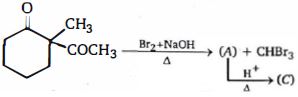
Product $(C)$ of the reaction is
Molal depression constant for water is ${1.86\,^o}C$. The freezing point of a $0.05\,molal$ solution of a non-electrolyte in water is