MCQ
Blue colour of sky is due to:
  • Scattering.
  • B
    Absorption.
  • C
    Reflection.
  • D
    Refraction.

Answer

Correct option: A.
Scattering.
Blue light is scattered the most. Hence, as sunlight travels the earth, most of the blue colour is scattered and hence spread. This causes the sky to appear blue in the day.

Need a full question paper?

Generate a complete, print-ready paper with questions like this in minutes — across 16+ boards, with answer keys.
Start Generating Free

Similar questions

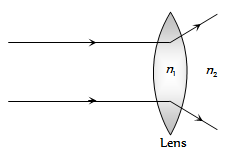
The relation between $n_1$ and $n_2$, if behaviour of light rays is as shown in figure is
Eight copper wire of length $l$ and diameter $d$ are joined in parallel to form a single composite conductor of resistance $R$. If a single copper wire of length $2\,l$ have the same resistance $(R)$ then its diameter will be $.....d$.
A uniform electric field having a magnitude $E_0$ and direction along the positive X - axis exists. If the potential V is zero at x = 0, then its value at X = +x will be 
A hydrogen atom makes a transition from $n = 2$ to  $n = 1$ and emits a photon. This photon strikes a doubly ionized lithium atom $(z = 3)$  in excited state and completely removes the orbiting electron. The least quantum number for the excited state of the ion for the process is
The resistivity of a wire
The relations amongst the three elements elements earth's magnettic fleld, namely horizontal component $H$, vertical component $V$ and dip $\delta$ are, $(  B_{E}=$ total magnetic fleld) 
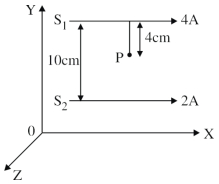
Two long parallel conductors $S_{1}$ and $S_{2}$ are separated by a distance $10 \,cm$ and carrying currents of $4\, A$ and $2 \,A$ respectively. The conductors are placed along $x$-axis in $X - Y$ plane. There is a point $P$ located between the conductors (as shown in figure).

A charge particle of $3 \pi$ coulomb is passing through the point $P$ with velocity

$\overrightarrow{ v }=(2 \hat{ i }+3 \hat{ j }) \,m / s$; where $\hat{i}$ and $\hat{j} \quad$ represents unit vector along $x$ and $y$ axis respectively.

The force acting on the charge particle is $4 \pi \times 10^{-5}(-x \hat{i}+2 \hat{j}) \,N$. The value of $x$ is
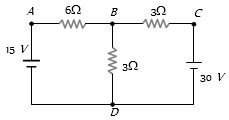
In the circuit shown in figure, find the current through the branch $BD$ ............. $A$
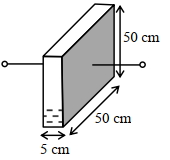
A container has a base of $50 \mathrm{~cm} \times 5 \mathrm{~cm}$ and height $50 \mathrm{~cm}$, as shown in the figure. It has two parallel electrically conducting walls each of area $50 \mathrm{~cm} \times 50 \mathrm{~cm}$. The remaining walls of the container are thin and non-conducting. The container is being filled with a liquid of dielectric constant $3$ at a uniform rate of $250 \mathrm{~cm}^3 \mathrm{~s}^{-1}$. What is the value of the capacitance of the container after $10$ seconds? [Given: Permittivity of free space $\in_0=9 \times 10^{-12} \mathrm{C}^2 \mathrm{~N}^{-1} \mathrm{~m}^{-2}$, the effects of the non-conducting walls on the capacitance are negligible]
A galvanometer gives full scale deflection with $0.006$ A current. By connecting it to a $4990 \ \Omega$ resistance, it can be converted into a voltmeter of range $0-30 \ V$. If connected to a $\frac{2 n }{249} \Omega$ resistance, it becomes an ammeter of range $0-1.5 \ A$. The value of $n$ is: